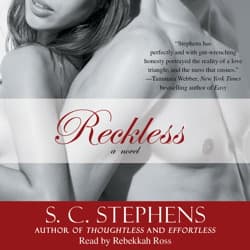

Look, I'll be upfront: this is not my usual territory. I spend most of my listening hours with Austen and Dostoevsky and dead men who took 400 pages to describe a whale. But Denise has been after me for months to try one of her favorites, and last Tuesday night, somewhere around hour three of grading sophomore essays on The Great Gatsby - half of which misspelled "Gatsby" - I caved. I put on Reckless by S.C. Stephens. And then I didn't take it off for three days.
This reminds me of what Hemingway said about writing true sentences. Not because Stephens writes like Hemingway - she absolutely does not, and that's fine - but because there's a specific kind of emotional honesty in this book that kept catching me off guard. Kiera and Kellan's relationship in this third installment has shed the messy love triangle drama of the earlier books and settled into something more interesting: two people who actually chose each other, now figuring out whether that choice can survive the machinery of fame.
When the Rock Star Actually Has to Be a Rock Star
What got me - what genuinely surprised me at 11:47 PM on a Wednesday while I was red-penning a kid's thesis statement - is that Stephens doesn't just use "fame" as a vague antagonist. She gets specific. There's a greedy label executive pushing Kellan toward a declining pop star for a publicity stunt, and Kiera has to watch this unfold while the media invents relationships that don't exist. The jealousy isn't cheap. It's earned. Kiera's growth from the earlier books actually matters here; she's not the same insecure narrator who drove readers crazy in Thoughtless. She's grown up. My students would hate this. I love it. That arc of watching a woman wrestle with identity while the world around her shifts — I got a similar gut-punch from Story of the Lost Child, though Ferrante's Naples and Stephens's rock-star tour bus don't exactly share a zip code.
The pacing, though - and I say this with affection - is indulgent. Twenty-one hours is a commitment. There are stretches in the middle where the band's tour life becomes repetitive, where another misunderstanding with another tabloid story starts to feel like the last one. Stephens trusts her readers to stay invested through those valleys, and mostly that trust is rewarded, but I'd be lying if I said my attention never wandered. (I graded an entire stack of vocabulary quizzes during one particular airport scene that went on for about forty minutes too long.)
Rebekkah Ross Knows These People
Here's where I want to push back on anyone who dismisses this as "just a romance audiobook." Rebekkah Ross's narration is genuine performance art. The narrator understands that pause is punctuation - and Ross uses silence the way a good actor uses the space between lines.
Her Kellan has this low, confident warmth that shifts just slightly when he's talking to Kiera versus when he's performing for the media. It's subtle. You might not catch it consciously, but your brain registers the difference. And Denny - the Australian ex-boyfriend who somehow remains a friend - Ross gives him this quiet, sweet accent that never slides into caricature. His vowels round out gently, and his delivery is softer, slower, which tells you everything about who Denny is before the text even spells it out.
Kiera herself sounds age-appropriate. Not breathy-young, not artificially wise. Just... a woman in her early twenties trying to hold onto something real while everything around her is turning synthetic. Ross is consistent across twenty-one hours, which is no small feat. I've listened to prestige narrators lose their grip on character voices by hour eight. Ross doesn't.
The Prose Deserves More Credit Than It Gets
I'm not going to pretend this is Middlemarch. (Though I will say: George Eliot would've had opinions about Kiera's emotional arc, and not all of them would be dismissive.) But Stephens does something that literary snobs - and yes, I'm looking in the mirror - tend to undervalue. She writes the interior life of romantic attachment with real specificity. The way Kiera describes watching Kellan perform and feeling simultaneously proud and terrified. The particular ache of seeing someone you love become public property. That's not easy to write. It's not easy to narrate, either, and Ross handles it without tipping into melodrama.
If you loved the first two books in the Thoughtless series, this is the payoff. If you're coming in fresh - don't. Go back. The emotional weight of this book depends entirely on the history these characters have built. It's the same principle behind any great series finale — you need the full journey to feel the landing. I had that exact experience with Return of the King, which earns its emotional crescendo only because you've walked every mile with those characters.
Worth Pausing the Faculty Meeting For
I finished this one walking the lakefront on Saturday morning, Denise two steps ahead of me because I'd slowed down during a scene near the end that I won't spoil. She turned around, saw my face, and just said, "Told you." Twenty years of marriage and she still gets to be right.
This isn't the kind of book I'd assign to my AP Lit class. But it's the kind of book that reminds me why people read in the first place - not for sophistication, but for feeling. And Rebekkah Ross makes that feeling land. If you're a romance listener who cares about narration quality, this is your 21-hour reward. If you're a literary snob like me who needs permission to enjoy something earnest and unapologetic - consider this your permission slip.