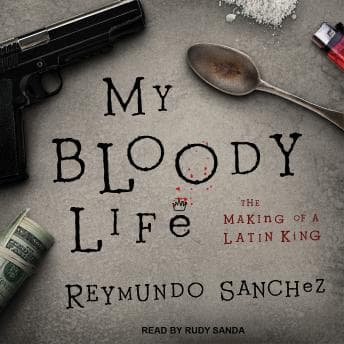

Everyone says the narration is the problem with this audiobook. And they're not wrong — but they're also missing the point.
I was up late, standing over a pot of dal that didn't need stirring anymore, phone propped against the spice rack, listening to Reymundo Sanchez describe how a child who just wanted to play baseball ended up holding a gun before he could legally drive. And I forgot about the narrator entirely. For hours. Because the psychology of this story is so relentlessly honest that it bulldozed right past the production issues.
The Making of a Case Study Nobody Assigned Me
Let me put on my researcher hat for a second, because this book is doing something that most true crime memoirs don't even attempt. Sanchez isn't performing redemption. He's not packaging his trauma into a neat arc where he learns his lesson by chapter twelve. The protagonist — himself — exhibits classic trauma bonding patterns with the Latin Kings, and what makes this fascinating is that he knows it while he's writing it but doesn't try to intellectualize it away.
Here's what I found myself asking: why does a kid who's been abused at home seek out an organization that will also abuse him? The research actually shows this is textbook — children who grow up with unpredictable violence often seek out environments where violence at least follows rules. The gang has codes, ranks, rituals. It's structured chaos versus the unstructured chaos of his home life. Sanchez never frames it this way explicitly, but every decision he describes maps perfectly onto attachment theory gone sideways. The Latin Kings become his family not despite the violence but partly because of it — because at least this violence comes with brotherhood speeches and loyalty oaths attached.
Twelve and a half hours. That's a commitment. And the pacing earns it, mostly. The early chapters covering his childhood abuse and the slow gravitational pull toward the gang are genuinely harrowing in a way that doesn't feel exploitative. Sanchez writes with the flat affect of someone who's processed these memories so many times they've become clinical. Which, psychologically, tracks perfectly — that emotional flattening is a hallmark of repeated trauma recall.
But the middle sections, once he's deep in Latin King life, start to blur. Incident after incident of violence, retaliation, more violence. It mirrors the numbing cycle of gang life itself, and I think that's partly intentional, but it does test your endurance around hours six through nine.
The Narrator Situation (Yes, We Need to Talk About It)
Okay. Rudy Sanda. Look, I'm the daughter of immigrants. I grew up hearing my parents' accents mocked, hearing Bollywood dialogue butchered by well-meaning white friends. So when I tell you that Sanda's attempts at accents made me physically wince in my kitchen at midnight — I'm not being precious about it. The Spanish inflections he puts on certain characters sound like someone doing an impression of an impression. It's distracting in a book that deserves better.
Here's the thing though: his baseline narration, when he's just reading Sanchez's prose straight, is actually decent. Clear, measured, doesn't oversell the emotional moments. The problem is specifically when he tries to differentiate characters through accent work he clearly isn't equipped for. A native bilingual narrator would've elevated this material significantly. Instead, you get moments where a deeply serious scene — someone getting jumped in, someone getting shot — is undercut by a voice that sounds like it belongs in a bad comedy sketch.
Listeners who praised his work in the sequel Once a King, Always a King suggest he improved. Good for him. But this audiobook is the one you're buying right now, and the narration is a genuine obstacle.
Who This Is Really For
If you study psychology, criminology, sociology — or if you just want to understand why young men join gangs beyond the lazy "they're bad kids" explanation that still dominates cable news — this is essential reading. The content is a raw, unflinching primary source. Sanchez doesn't ask for your sympathy, which paradoxically makes him more sympathetic. I noticed the same quality in Rogue Lawyer — that refusal to perform likability is often what makes a narrator land hardest. He presents cause and effect with the honesty of someone who's stopped trying to impress anyone.
If you need polished audio production or strong voice acting to stay engaged, read the print version instead. I'm serious. The story deserves your attention; this particular audio format partially undermines it.
Content warnings are real here — childhood abuse, sexual content, graphic violence, language. This isn't true crime entertainment. It's a trauma memoir that happens to involve crime.
My Therapist Would Have a Field Day
I keep thinking about one thread running through the whole book: Sanchez's repeated inability to leave, even when he sees what the gang is costing him. It's the same pattern I see in abusive relationship research — the sunk cost fallacy fused with identity dissolution. When your entire sense of self is built around membership in something, leaving isn't just logistically dangerous. It's psychologically equivalent to ego death.
That's what makes this book worth the twelve hours and the imperfect narration. Not the violence. Not the shock value. The why. Sanchez gives you the why, and it's more uncomfortable than any of the bloodshed — because the why is recognizable. Human. The patterns are there if you're willing to see them.
Read it. Just maybe read it in print.