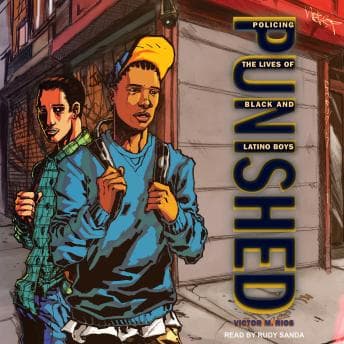

I was making dal makhani at 10 PM on a Tuesday—the kind of elaborate cooking project that signals I'm avoiding something (in this case, a literature review that refuses to write itself)—when Victor Rios started describing how a fourteen-year-old named Tyrell had already been stopped by police forty-seven times. Forty-seven. I burned the onions.
This is the kind of book that makes you angry in productive ways. And as someone who studies how narratives shape identity, I found myself taking mental notes like I was observing a clinical case study. Except these aren't cases. They're kids.
The Criminalization Feedback Loop Is Real Psychology
Rios introduces what he calls the "youth control complex"—this web of institutions (schools, police, probation officers, even community centers) that collectively mark certain boys as criminal before they've done anything. Classic labeling theory in action, except multiplied across forty young men over three years of ethnographic research.
What makes this compelling is that Rios isn't some distant academic parachuting into Oakland for data. He grew up there. Former gang member. Juvenile record. Insider-outsider positioning in ethnography produces different—arguably richer—access to subjects' inner lives. And you hear it. When he describes how these boys navigate what he calls "dignity work"—trying to maintain self-respect while being constantly surveilled—there's an intimacy that pure outsider research rarely achieves.
Psychologically, the mechanism he documents is devastating: punish kids for minor infractions, watch them internalize the criminal identity, then punish them again when they act accordingly. It's a self-fulfilling prophecy with handcuffs.
Rudy Sanda's Narration: Serviceable, Not Transformative
Here's where I have to be honest about the gaps in what I can assess. I didn't find specific complaints or praise about Sanda's performance, and listening through, I'd say he's... fine? He reads clearly, maintains appropriate gravity for the subject matter, and doesn't get in the way of Rios's arguments.
For reference, I've heard Sanda in very different territory—Dawn: Final Awakening Book One is post-apocalyptic thriller material, and even there the performance didn't leave much of an impression on me (2.5 stars says something).But "doesn't get in the way" is different from "elevates." For an academic text with this much emotional weight—kids being arrested at school, boys describing how they learned to expect prison—I wanted more vocal range. More differentiation when Rios quotes the young men directly versus his analytical passages. Sanda treats it all with the same measured tone, which feels slightly flattening for material this urgent.
At just under nine hours, it's a reasonable commitment for serious nonfiction. I'd recommend 1.0x speed despite my usual preference for faster—you need time to sit with some of these stories.
Where the Research Gets Uncomfortable (In a Good Way)
Rios doesn't let anyone off the hook. Not the police, obviously, but also not schools that suspend kids for "looking suspicious," not community programs that reinforce surveillance under the guise of help, not even parents who sometimes participate in the punitive system because they don't know what else to do.
I found myself asking: why does "helping" marginalized youth so often look like controlling them? Rios has an answer, and it's not flattering to well-intentioned liberals. (My therapist would have thoughts about this—specifically about how institutions replicate harm while believing they're doing good. We've discussed this pattern in other contexts.)
The boys themselves are drawn with genuine complexity. They're not romanticized as noble victims or demonized as irredeemable. They make bad choices. They also make strategic choices that look bad but are actually rational given their constraints. A fascinating study in how context shapes behavior—something psychology textbooks often flatten into abstract principles.
Who Should Listen (And Who Should Sit With Discomfort)
If you're in education, social work, criminal justice, or policy—this is required listening. Not because it offers easy solutions (it doesn't), but because it documents the lived experience of systems you might be part of. If you're a parent in a comfortable suburb who's never had to explain to your kid why police might treat them differently—this will be uncomfortable. Good. Sit with it.
Skip if you need audiobooks to be background noise. This demands attention. There's violence described, abuse documented, and language that reflects how these young men actually talk. Content warnings are appropriate.
The Dal Makhani Verdict
I finished the dal makhani eventually. It was fine. The book was better.
What Rios accomplishes here is rare: rigorous academic research that reads like narrative journalism, delivered with the credibility of someone who lived it. The 2012 Best Book Award from the Latino/a Sociology Section wasn't just professional courtesy—this work matters.
Does the audiobook format add something the print version lacks? Marginally. Sanda's narration is competent without being memorable. But there's something about hearing these boys' words spoken aloud that makes the academic framework feel more human.
Identity formation happens through the stories we're told about ourselves. These forty young men were told they were criminals before they had the chance to be anything else. Rios documents what happens next—and occasionally, what happens when someone manages to rewrite that narrative.
That's the part that stayed with me past midnight, long after the cooking was done.