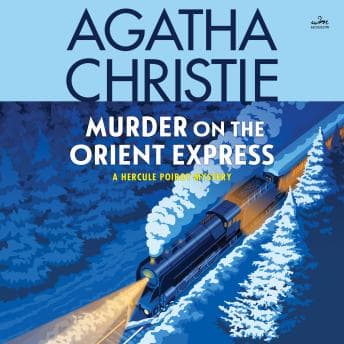

"The murderer is with us—on the train now."
That line hit different at 4:47 AM, charting in a dim corner of the trauma unit while my one stable patient slept. The ward was so quiet I could hear the ventilators two rooms over, and Suchet's Poirot was whispering about a dead man in a locked compartment, and honestly? For about thirty seconds I forgot I was in a hospital in Phoenix and not stuck on a snowbound train somewhere in Yugoslavia.
Suchet IS Poirot and That's the Whole Problem and the Whole Point
Let me get this out of the way: David Suchet doesn't narrate Poirot. He inhabits him. That precise, fussy Belgian-French cadence—the way he rolls his Rs and clips his consonants when Poirot is irritated—it's the same voice from the ITV series that my mom watched religiously on Sunday afternoons. (My mom would love this. She still thinks I should've been a doctor, but she'd forgive me anything if I told her I was listening to "the real Poirot.")
But here's where it gets complicated. Suchet gives every single character on that train a distinct voice. The Russian princess gets this imperious, slightly breathless tone. Mary Debenham is clipped and English. And then there are the female voices that—look, I need to be honest—get shrill. Like, uncomfortably shrill. There's a particular character voice, I think it was Mrs. Hubbard, where the pitch goes so high that I actually winced and turned down my car volume on the drive home one morning. Carlos was already awake making coffee when I walked in, and I was still rubbing my ear.
Some listeners have called Suchet's accents exaggerated to the point of being hard to understand. I didn't have that problem exactly, but I can see it. Whispers in the Dark has a similarly ambitious multi-character narration that pulled off the same trick without making me wince, so it's not impossible—just genuinely hard. When you've got a dozen characters from different nationalities all being voiced by one man doing his absolute best to differentiate them—Italian, Swedish, Hungarian, American—some of those accents are going to wobble. It's ambitious. Sometimes ambitious means brilliant. Sometimes it means you're squinting at a sentence trying to figure out what just happened phonetically.
Christie Wrote a Locked Room on Rails and It Still Works
I've read this book. I've seen the movies—both the Branagh version and the 1974 one with Albert Finney. I know who did it. You probably know who did it. The twist is one of the most famous in mystery fiction.
And it STILL got me.
That's Christie's actual genius. The solution isn't the point—the architecture is. Poirot interviews each passenger one by one, peeling back alibis like layers of gauze (sorry, occupational metaphor), and each conversation shifts your suspicion just slightly. The medical details are accurate. Finally.—okay, there aren't many medical details here, it's a stabbing, but Christie doesn't make the mistake so many thriller writers do of having the body discovered in some medically impossible state. Twelve stab wounds, some deep, some shallow, some at odd angles. That observation actually matters to the plot, and it's the kind of detail I appreciate because it respects the reader's intelligence.
At six hours and forty-five minutes, this is a tight listen. No bloat. No subplot about Poirot's tortured past. Just a dead body, a snowdrift, and a detective with a magnificent mustache and even more magnificent ego asking very precise questions. The pacing feels slower than a modern thriller—this is 1934 storytelling, after all—but I'd call it deliberate rather than draggy. It's a slow burn that earns its payoff.
Who Gets a Ticket on This Train
If you want a classic mystery done right in audio, and you grew up with Suchet's Poirot on television, this is going to feel like coming home. Night shift approved—it's engaging enough to keep you alert during charting but not so intense that you're going to have an adrenaline spike.
If you're sensitive to exaggerated character voices or you find theatrical narration grating, you might want the Dan Stevens version instead. Suchet is performing this, not just reading it. That's a feature for some people and a bug for others.
I'd also say this needs your attention. Don't throw it on while you're scrubbing the kitchen or running errands. Christie plants clues in single sentences. Miss one and the ending won't land as hard.
My Prescription: One Orient Express, As Needed for Quiet Shifts
I didn't yell at my dashboard during this one. Not once. And for a mystery audiobook, from me, that's basically a standing ovation. Suchet's Poirot is the definitive version—shrill female voices and all—and Christie's puzzle box plotting holds up ninety years later. Carlos asked why I was smiling in the car. I told him a little Belgian man just outsmarted everyone on a train. He didn't ask follow-up questions. Smart man.