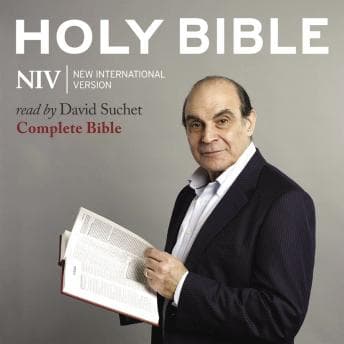

Eighty-three hours. Let me just sit with that number for a second. Eighty-three hours and thirty-four minutes of one man reading the entire Bible, cover to cover, Genesis to Revelation. I didn't plan to listen to the whole thing in sequence — I'm not a masochist — but I kept coming back to it during those late-night cooking sessions where I'm making dal makhani for one and pretending that's a lifestyle choice, not a situation. And somewhere between Leviticus and Job, I realized I'd been pulled into something I wasn't expecting from what is, essentially, the oldest text in the Western canon read aloud by the guy who played Poirot.
Hercule Poirot Reads You the Word of God (And It Works)
Here's my complaint: I kept waiting for Suchet to slip into Poirot. I kept listening for that precise, fussy Belgian cadence to creep in during, say, one of the Proverbs. "Ze little grey cells, they tell me that ze fear of ze Lord is ze beginning of wisdom." It never happened. Not once. And that's actually the most impressive thing about this recording — David Suchet, a man who inhabited one of fiction's most distinctive characters for twenty-five years, completely disappears into the text. His voice is deep, unhurried, British in that warm BBC way, and remarkably free of performance ego. He doesn't try to "do" Moses. He doesn't give God a booming James Earl Jones thing. He reads with subtle inflection, letting the weight of the language carry itself.
Psychologically, this is fascinating to me. Suchet became a Christian at forty — relatively late for someone raised in the West — and you can hear that convert's intentionality in his delivery. There's a quality of attention that suggests he's not just reading words; he's processing them. The research actually shows that when people narrate material they have genuine emotional investment in, listeners can detect that authenticity at a neurological level. Your brain knows the difference between someone phoning it in and someone who means it. Suchet means it.
The 200-Hour Intimacy Problem
So here's the tension. A single narrator reading the entire Bible is an act of almost absurd ambition. Over 200 hours in the studio. No co-narrators, no sound effects, no musical interludes. Just Suchet and the NIV text. And for long stretches — particularly the Psalms, Isaiah, the Gospels — this works beautifully. His reading of Ecclesiastes has this weary, almost clinical melancholy that hit me at 1 AM on a Tuesday in a way I genuinely wasn't prepared for. "Meaningless, meaningless, everything is meaningless" — delivered not with theatrical despair but with the quiet resignation of someone who's actually thought about it.
But — and this is a significant but — the single-narrator format struggles with the more dialogue-heavy books. In the Gospel narratives, when Jesus is speaking to Peter who's speaking to the crowd who's responding to the Pharisees, the lack of distinct character voices means you sometimes lose track of who's talking. Suchet uses subtle shifts in register, sure, but subtle can become indistinguishable during a long drive or a distracted listen. I found myself rewinding more than once through Acts because I'd lost the thread of a conversation.
And the app navigation issues? Real. I primarily used Audible, which helped, but listeners who've used the dedicated app report playback restarting after pauses and difficulty jumping to specific books or chapters. For a text that people specifically want to navigate by chapter and verse, that's not a minor annoyance — it's a structural failure of the platform.
Who This Is Really For (Be Honest With Yourself)
This isn't background listening. I tried it during a jog through Cambridge once and basically retained nothing from Numbers, which — okay, fair, that might just be Numbers. But the density of the text demands attention. If you're looking for something to half-listen to while cleaning, this isn't it.
Who will love this: anyone who wants a sustained, meditative engagement with the Bible as literature and as spiritual text. Anyone who appreciates restraint over spectacle. Anyone who, like me, is interested in how a single human voice can carry the psychological weight of thousands of years of narrative — the jealousy of Cain, the grief of David, the existential crisis of Job, the radical compassion in Luke — without turning it into a performance. Honestly, Matilda is one of the few other audiobook experiences I'd put in the same category for this — a narrator who treats the text with genuine respect rather than showmanship, and you feel the difference in your chest.
Who should skip: if you want a full-cast production, dramatic scoring, or anything resembling the Bible Experience (which is a whole different animal), this will feel too quiet. Too still. And if you struggle with the NIV translation specifically, that's what you're getting here — no King James grandeur, no Message paraphrase casualness.
My Clinical Assessment (My Therapist Would Approve)
I came to this as a researcher of narrative psychology, not as a theologian. And what struck me most is how Suchet's reading reveals the Bible as what it fundamentally is: an anthology of human psychological case studies. Jealousy, betrayal, grief, hope, irrational faith, justified rage. His even-handed delivery lets you hear the patterns without editorializing them. That's rare, and it's worth something — even if the app might restart on you mid-Deuteronomy.