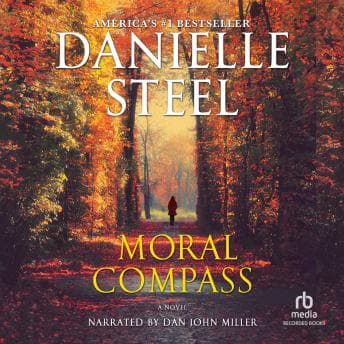

Danielle Steel wrote a campus assault novel, and I have feelings about it.
Look, I teach teenagers. I've spent two decades watching them navigate the gap between who they are and who their parents want them to be. So when a book promises to explore privilege, sexual assault, and moral reckoning at an elite prep school, I'm in. That's my wheelhouse. That's my Tuesday. I put this on during a Saturday morning walk along the lakefront with Denise, and within the first hour she asked me why I kept sighing. By hour three, I was sighing for different reasons than she assumed.
The After-School Special That Wants to Be a Courtroom Drama
Here's the setup: Saint Ambrose Prep goes co-ed for the first time, a girl gets assaulted at a Halloween party, and the rest of the book tracks the fallout across a constellation of families - wealthy, less wealthy, divorced, intact, functional, deeply dysfunctional. Steel rotates through perspectives like she's checking names off a roster. And that's precisely the problem. There are so many characters that none of them get enough oxygen. You'll meet a kid, learn that his parents are getting divorced or his mother drinks too much or his father is a famous director, and then Steel will tell you how that makes the kid feel. Directly. Explicitly. Repeatedly.
I'm not exaggerating about the repetition. The book circles back to the same information - who was at the party, what the parents do for a living, which families can afford attorneys - like a student padding a five-page essay to hit the word count. I've read those essays. I've graded thousands of them. I know padding when I hear it. And Dan John Miller, bless him, has to narrate every single recap with the same energy as the original revelation. It's a tough ask.
Dan John Miller Does What He Can With What He's Got
Miller is a veteran Steel narrator, and you can hear the professionalism. His voice is warm, steady, pleasant to listen to in the way a well-made piece of furniture is pleasant to look at - nothing flashy, nothing offensive, nothing you'd write home about. He gives slight inflections to differentiate characters, but "slight" is doing heavy lifting in that sentence. In a book with this many speaking parts - students, parents, teachers, cops, lawyers, media - you need more than slight. You need range. What you get instead is a kind of measured calm that works fine during the courtroom-adjacent scenes but falls flat during moments that should hit you in the chest.
The bigger issue is that there's almost no dialogue to perform. Steel narrates through her characters rather than letting them speak. So Miller is essentially reading summary for long stretches, and at 1.0x speed - yes, I kept it at 1.0x, because the author chose those words - I could feel the prose flattening out. There were stretches in hours four and five where I genuinely couldn't tell if Miller sounded bored or if the material had just gone monotone on him. Probably both. Probably the narrator reflects the energy of the page, and when the page is telling you for the fourth time that Jamie Elliot's father is a powerful man, even a good narrator is going to sound like he's reading a deposition.
What Hemingway Said About the Iceberg
This reminds me of what Hemingway said about writing - the dignity of movement of an iceberg is due to only one-eighth of it being above water. Steel's approach is the inverse. Everything is above water. Every emotion is labeled, every moral implication is spelled out, every character's internal state is narrated to you as if the reader (listener) can't be trusted to infer anything. It's a book about a moral compass that never stops pointing at its own title.
And that's frustrating because the bones of this story are strong. The question of what happens when privilege meets accountability is genuinely important. The way families fracture under pressure, the way kids protect each other out of loyalty or fear, the way institutions choose reputation over justice - these are real dynamics. I see versions of them play out in my own school. Not at this scale, not with this kind of money, but the DNA is the same. Steel sees it too. She just doesn't trust the story to carry itself.
My students would hate this. But not for the reasons I'd want them to.
Who Gets an A, Who Gets a Pass
If you're a devoted Danielle Steel reader who wants a contemporary issues novel you can follow without much effort, this will work for you. Seven hours isn't a huge commitment, and Miller's voice is genuinely easy on the ears even when the material goes circular. But if you're looking for a campus assault narrative with real psychological depth - something that sits with ambiguity and makes you uncomfortable - this isn't it. Try Tana French instead. Or just rewatch "The Hunting Ground" and sit with the silence afterward.
The Grade on This One
I finished it. I didn't love it. I didn't hate it. It felt like grading a paper from a student who picked a great topic but summarized the Wikipedia article instead of writing an actual argument. The pieces were all there. The assembly was the problem. Worth streaming if you're curious, but don't spend a credit on it. Save that for something that earns its pauses. My review of Secretly Yours is a case where I'd say the same thing — pleasant enough to stream, but a credit would've felt like overpaying for a meal that looked better on the menu.