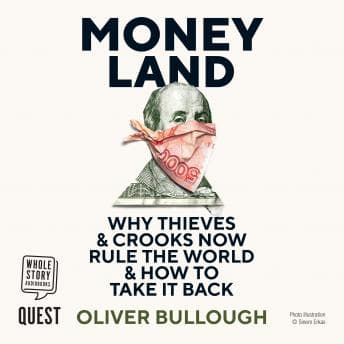

What happens when you give kleptocrats the keys to Western finance? You get Moneyland. And you get a book that should be required listening for anyone who's ever wondered why luxury condos in London sit empty while oligarchs' yachts grow larger than destroyers.
I finished this on a red-eye to Singapore, 2.0x speed, unable to sleep. Not because of turbulence—because Oliver Bullough kept dropping facts that made me want to shake the seat in front of me. My seatmate thought I was having a medical episode. I was just processing how thoroughly we've been played.
The Consulting Gig Nobody Talks About
Here's what Bullough does brilliantly: he traces the plumbing. Not the sexy heist stuff, but the actual infrastructure—how money moves from a Ukrainian minister's pocket to a Mayfair townhouse. The bankers in London who figured out in the 1950s that they could hold dollars without being subject to US regulations? That's your origin story. That's your patient zero.
My parents ran a dry cleaning business in Koreatown. They reported every dollar. Filed every form. Meanwhile, Bullough documents how billions flow through shell companies in Delaware—yes, Delaware—with less paperwork than my mom needed to buy a used Honda. The asymmetry is infuriating. And Bullough knows it.
He's not neutral about this. He's Welsh, he's spent years in the former Soviet Union, and you can hear the controlled fury in his narration. When he describes visiting the estates bought with stolen money, there's this dry precision that hits harder than outrage would. Author-narrated business books can go either way—sometimes you get monotone academics. Bullough sounds like a journalist who's seen too much and wants you to see it too.
Nine Hours That Respect Your Time
At 9 hours 38 minutes, this is dense but never bloated. The key insight—that we've created a parallel legal system where the rich exist outside national jurisdiction—gets established early. Then Bullough just keeps stacking evidence until you're drowning in it.
The structure works: historical context, then case studies, then the "how to fix it" section at the end. Skip to chapter 5? Actually, no. For once, the setup matters. You need to understand how the Eurodollar market evolved to appreciate why a Ukrainian gangster can buy a $100 million apartment in Manhattan with no questions asked.
I've seen this fail at three different companies—clients who thought compliance was a checkbox, not a culture. Bullough explains why that attitude exists. When the system rewards opacity, transparency becomes a competitive disadvantage. It's not a bug. It's the feature.
The Legitimate Institutions That Enable All of It
The most damning sections involve law firms, real estate agents, private schools—institutions that have built entire business models around not asking questions. Bullough visits a Nevada company formation agent who can set up an anonymous LLC in fifteen minutes. The agent isn't breaking any laws. That's the point.
Jenny would say I'm being harsh. Jenny is right—but only about my delivery, not my conclusions. This book confirms every cynical suspicion I've developed watching wealth accumulation up close. The difference between legal and illegal at the top? Mostly just paperwork and the right lawyers.
Bullough's narration stays accessible throughout. No financial jargon for its own sake. When he explains how trust structures work, you actually understand them. When he describes the lifestyle of kleptocrats—the private jets, the shopping sprees, the absolutely insane real estate—it reads like satire. It isn't.
Who Gets Value Here (And Who Doesn't)
Consultants, policy wonks, anyone in financial services who wants to understand the ecosystem they're swimming in. If you advise wealthy clients, this is useful context. If you work in compliance, it's a horror story. If you're just a citizen wondering why the rules seem to apply differently based on net worth—welcome to the club.
Skip this if you want actionable investment advice. The "how to take it back" section is the weakest part—Bullough's better at diagnosis than prescription. Also not ideal for casual background listening. This requires attention.
The ROI Calculation
I've listened to dozens of business books about wealth and corruption. Most are either too academic or too conspiratorial. Bullough threads the needle—investigative journalism with enough context to understand why this matters and enough specificity to remember the examples. That same balance between depth and accessibility shows up in Mastery, though Greene's hunting for patterns in genius rather than kleptocracy.
The 2.0x speed worked fine. His pacing is measured but not slow. No production issues, no weird audio artifacts. Just a journalist walking you through the architecture of modern kleptocracy.
My parents never got to read about passive income. They were too busy working. Meanwhile, the system Bullough describes was being built around them—designed to protect wealth that was stolen, not earned. That's not a political statement. That's just what the data shows.
Buy it. Listen on your commute. Get angry. Then figure out what you're going to do about it.