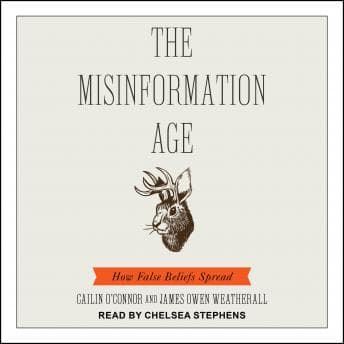

False beliefs don't spread because people are stupid. That's the core argument of The Misinformation Age, and it's a surprisingly liberating one. Philosophers Cailin O'Connor and James Owen Weatherall want you to stop blaming individual psychology for the epidemic of fake news and start looking at something far more interesting: the social networks that shape what we believe.
I found myself listening to this during my morning runs, and something about the rhythmic pacing of Chelsea Stephens' narration matched perfectly with the methodical way the authors build their case. They're not here to make you feel superior to conspiracy theorists or anti-vaxxers. Instead, they demonstrate through mathematical models and historical examples how perfectly rational people, following perfectly reasonable strategies for updating their beliefs, can end up collectively believing things that are demonstrably wrong.
The book draws heavily on philosophy of science, but don't let that scare you off. O'Connor and Weatherall are remarkably skilled at translating academic concepts into accessible language. They walk you through scenarios involving simplified communities of scientists trying to discover truth, showing how even small biases in how information flows can lead entire groups astray. The tobacco industry's decades-long campaign to manufacture doubt about smoking's health effects serves as a recurring case study—and it's genuinely chilling to hear how deliberately corporations exploited the natural dynamics of scientific consensus.
Chelsea Stephens Knows When to Get Out of the Way
Stephens handles this material with the kind of clear, measured delivery it demands. She doesn't try to dramatize the content or inject artificial energy. The prose is already doing heavy lifting, packed with ideas that require genuine attention, and her straightforward approach lets you focus on absorbing the arguments rather than processing vocal flourishes. Her pacing remains consistent throughout the six-and-a-half-hour runtime, which matters when you're dealing with concepts that build on each other chapter by chapter.
Conformity Isn't the Villain You Think It Is
What struck me most was the book's treatment of conformity. We tend to think of it as a weakness, a failure of independent thinking. Reasoning With An Optimist explores a different angle on belief formation—whether our assumptions about consciousness itself might be leading us astray. But O'Connor and Weatherall show how conformity bias actually serves an important function in helping communities converge on truth—until it doesn't. When bad actors understand these dynamics, they can exploit them systematically. The authors aren't just describing a problem; they're mapping the terrain so we can better navigate it. That same systematic approach to dismantling accepted wisdom appears in Der Antichrist, though Nietzsche's target is institutional morality rather than information networks.
The academic credentials of the authors shine through in the rigor of their arguments. Both teach logic and philosophy of science at UC Irvine, and Weatherall previously wrote The Physics of Wall Street, a New York Times bestseller. They know how to communicate complex ideas to general audiences without dumbing them down. The research feels thorough, the examples well-chosen, and the conclusions appropriately modest. They're not claiming to have solved the misinformation crisis. They're offering a framework for understanding it.
Fair Warning: This One Requires Your Full Attention
There are moments where the book gets dense. The mathematical models, while explained clearly, require concentration. If you're looking for something to half-listen to while doing chores, this isn't it. I had to rewind several sections during particularly distracted stretches of my runs. But that density is also what makes the book valuable. It's not offering easy answers or simple villains. It's asking you to think carefully about how beliefs actually propagate through communities.
The production quality is clean throughout—no audio glitches, no distracting background noise, just professional narration of substantive material. Stephens maintains professionalism without becoming robotic, finding that sweet spot where you forget about the narrator and focus on the ideas.
What makes this audiobook particularly worth your time is its timeliness paired with its depth. Plenty of books have been written about fake news and misinformation since 2016, but most focus on individual cognitive biases or platform algorithms. O'Connor and Weatherall go deeper, examining the fundamental social structures that make us vulnerable to false beliefs in the first place. Understanding these dynamics won't make you immune to misinformation, but it might make you more humble about your own susceptibility—and more effective at thinking about solutions.
The authors end with some practical implications, though they're careful not to oversell simple fixes. If the problem is fundamentally social rather than individual, then individual fact-checking, while valuable, won't be sufficient. We need to think about how information flows through our communities and what structural changes might help truth win out more reliably.
Who Should Queue This Up (And Who Should Skip)
If you're genuinely curious about why smart people believe false things—and want the philosophical framework rather than just outrage fuel—this is essential listening. Skip it if you need background audio or prefer your nonfiction with more narrative momentum; the mathematical modeling sections will lose you.