
When Self-Help Gets Philosophical (And I Mean That as a Compliment)
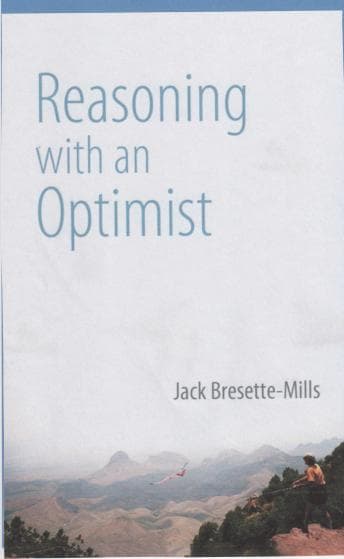
Okay, so I went into this one skeptical. The title alone - "Reasoning With An Optimist" - had me bracing for the kind of toxic positivity that makes my research-trained brain want to scream into a pillow. But here's the thing: Jack Bresette-Mills isn't selling you a vision board. He's asking you to run experiments on your own belief system. And honestly? That's pretty much exactly how I approach my own work.
The premise is deceptively simple. Can we test whether the world is "alive and aware of us"? Now, before you roll your eyes (I see you, fellow academics), this isn't woo-woo mysticism dressed up in fancy language. It's more like... what if we treated our relationship with reality the way a good scientist treats a hypothesis? What if optimism wasn't about ignoring evidence but about choosing which evidence to weight?
I found myself asking: why does this framework feel different from the usual self-help fare? The research actually shows that belief systems operate like self-fulfilling prophecies - we find what we're looking for. Bresette-Mills seems to get this intuitively. He's not telling you the universe loves you. He's suggesting you might want to find out for yourself.
The Voice Behind the Philosophy
Here's where author-narrated audiobooks can go very right or very wrong. (Don't get me started on the physicist who narrated his own book like he was reading a grocery list. My therapist would have thoughts about that guy.) Bresette-Mills falls into the "very right" category. His delivery is clear and thoughtful - you can tell he's actually thinking about what he's saying, not just performing it.
The pacing works beautifully for this kind of introspective content. He gives you space to sit with ideas, which matters when someone's essentially asking you to reconsider your entire worldview. At just under three and a half hours, it's the perfect length for a book like this. Long enough to develop the concepts, short enough that it doesn't overstay its welcome.
When an author reads their own philosophical work, you're getting the intended emphasis, the natural pauses where they want you to reflect. It's like having a conversation with someone who's genuinely thought deeply about these questions rather than just assembled talking points.
The Psychology Nerd's Take
Let me put on my behavioral psychologist hat for a second. (It's metaphorical. I don't actually have a hat. Though maybe I should get one.) The core mechanism Bresette-Mills is playing with - using your "sense of health" as a guide to belief adjustment - actually tracks with what we know about embodied cognition. Our bodies often know things before our conscious minds catch up.
The protagonist of this book, if we can call the reader that, exhibits classic patterns of someone ready for cognitive restructuring. You're invited to manipulate your belief system not through force but through experimentation. That's surprisingly sophisticated for a book that markets itself as "short and simple."
Psychologically, this does track. The whole "is the world alive and aware" question isn't really about metaphysics - it's about whether you approach life as a participant in something responsive or as a victim of random chaos. That distinction changes everything about how people make decisions, handle setbacks, form relationships.
If you're interested in the behavioral side of self-improvement, Atomic Habits tackles the mechanics of habit change, though James Clear focuses less on the philosophical underpinnings.
I listened to most of this during my morning jogs through Cambridge, and something about the combination of physical movement and these philosophical prompts worked. Maybe it's the endorphins. Maybe it's that exercise already puts you in a state of testing your limits. Either way, the ideas stuck differently than they would have if I'd been sitting at my desk.
Who Should Listen (And Who Should Skip)
This is a fascinating case study in how to make philosophy accessible without dumbing it down. If you're the type who reads psychology papers for fun (hi, it's me), you'll appreciate the intellectual honesty here. If you're burned out on self-help books that promise transformation through five easy steps, this might restore your faith in the genre.
But look - if you want something fast-paced or dramatic, skip this one. The narration is calm, the pace is deliberate, and the content requires you to actually engage. You can't half-listen while doing something else and expect to get much out of it.
I'd recommend 1.0x speed, maybe 1.1x if you're impatient. Any faster and you'll miss the spaces between ideas, which is kind of the whole point.
Would I listen again? Probably. There's enough depth here that a second pass would likely surface things I missed. And at three hours, it's not exactly a massive time commitment. My mother would still say I don't need another audiobook when I already have so many, but she doesn't understand how this works.