
"I became the killer. I became the victim."
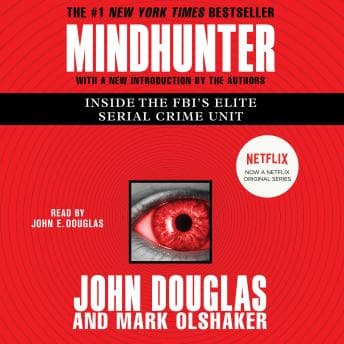
That line hit me somewhere around hour one, and I had to pause my Figma file because my hands were shaking. Not from fear exactly - from the weight of someone saying that and meaning it literally. John Douglas spent twenty-five years crawling inside the minds of the worst people who ever lived, and he's telling you about it himself, in his own voice, like he's sitting across from you at a bar at 2 AM and he's finally ready to talk.
Let me back up. I don't do true crime. My wheelhouse is romance, memoir, books that make me cry in the good way. Though I'll admit when I do wander into darker territory, something like Flicker in the Dark is usually my gateway - it scratches that psychological itch while still feeling like fiction I can put down and walk away from. But I'd watched the Netflix series during a particularly brutal freelance drought last year - Diego curled on my lap, Frida judging me from the bookshelf - and something about the real Douglas nagged at me. The show gave us Jonathan Groff's quiet intensity, but I wanted the actual man. So when I saw this was only three hours and narrated by Douglas himself, I figured I could squeeze it between client projects on a slow Tuesday.
Three hours. I did not work that Tuesday.
The Man Behind the Profile Reads His Own Scars
Here's the thing about author-narrated true crime: it can go very wrong. Some authors sound like they're reading a government report. Douglas doesn't. His voice has this worn-leather quality - he's not performing, he's remembering. There's a difference. When he talks about the Alaska case - Robert Hansen, the guy who literally hunted women in the wilderness like animals - you can hear Douglas's jaw tighten. It's subtle. A slight pause before certain details, like he's deciding how much to give you. That restraint says more than any dramatic narrator voice could.
But I won't lie - he's not Julia Whelan. He's not even trying to be. His pacing is steady, almost methodical, which makes sense for a man who built his career on systematic thinking. There are moments where the delivery flattens out during procedural sections about FBI bureaucracy and unit development. If you need vocal fireworks, this isn't it. What you get instead is authenticity so raw it makes the hair on your arms stand up.
When He Talks About Ed Gein, I Turned On Every Light in My Apartment
The case details are - okay, content warning, genuinely - graphic. Douglas doesn't sensationalize, but he doesn't sanitize either. The Ed Gein sections, where he describes what investigators found in that house (the skin, the furniture made from body parts, the things I can't unsay), made me physically nauseous. And I say this as someone who grew up watching telenovelas where people get pushed off cliffs weekly.
But what got me - what actually made me tear up, which I did NOT expect from a serial killer book - was the victim-centered stuff. Douglas keeps coming back to the victims. He talks about the Atlanta child murders with this quiet fury that three hours of narration can't contain. You can tell which cases broke something in him. The Green River investigation, the one that literally hospitalized him (viral encephalitis, nearly killed him), comes through not as a war story but as a confession. Like he's still not sure the cost was worth it.
Abuela would have HATED this book. She would've crossed herself fourteen times and told me I was inviting evil spirits into my apartment. But she also would've stayed up listening to every second, because she understood that sometimes you look at the darkness to understand the light. She was like that - rosary in one hand, telenovela remote in the other, deeply curious about the worst and best of people.
Three Hours Is Both Too Short and Exactly Right
At three hours, this is clearly an abridged version of the full book, and you feel it. Some cases get barely a paragraph. The Manson and Bundy interviews are mentioned more than explored. If you've read the print edition (which I haven't, but friends have told me), you're getting the highlight reel here. That said - for an audiobook experience, especially one narrated by the man himself, the brevity works as an entry point. It's concentrated. No filler.
The lack of music or sound effects is actually a blessing. It's just Douglas talking. Just a man and a microphone and twenty-five years of looking at crime scenes that would destroy most people.
Who Needs This In Their Ears
If you loved the Netflix series and want the real story - buy this immediately, it goes so much deeper even in three hours than two seasons of television. If you're a true crime person who's somehow never read Douglas, this is your origin text. If you're like me and don't usually touch this genre, it's a surprisingly human entry point - more memoir than murder manual.
Skip it if: you need extensive case detail (get the unabridged print), you want a polished narrator performance, or you're in a headspace where graphic violence descriptions will wreck you. Respect your own limits.
Frida Knocked My Headphones Off the Desk and Honestly, Fair
I came out of this feeling like I'd had a three-hour conversation with someone who's seen the absolute worst of humanity and still gets up every morning. That's not nothing. My heart didn't break the way it does with romance - it just sat heavy in my chest, like a stone I couldn't put down. Different kind of emotional experience, but emotional all the same. At 1.0x speed, those three hours felt both intimate and insufficient. I want more of this man's voice telling me terrible, important things.