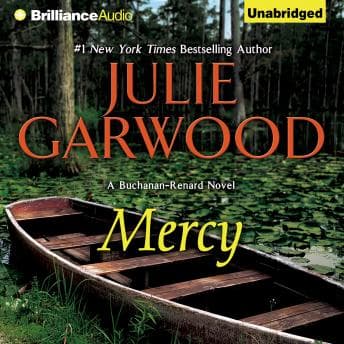

What happens when you take a group of white-collar professionals, give them a pact involving millions in offshore accounts, and then introduce the concept of "mercy killing" into their already morally bankrupt arrangement? You get a fascinating case study in how otherwise rational people rationalize the unthinkable. Julie Garwood's Mercy isn't reinventing the thriller-romance hybrid, but it does something I appreciate: it gives its villains actual psychological scaffolding.
I was chopping onions for a dal that was going to take two hours anyway - my mother's recipe, which she insists I'm doing wrong even over the phone - when I pressed play on this one. Twelve hours and fourteen minutes later, I had opinions.
The Sowing Club Is the Real Story Here
Let's talk about what Garwood gets right. The Sowing Club - four professionals bound by greed and a mutual agreement to let their stolen fortune grow - is a genuinely interesting villain construct. The leader, John, turns to his co-conspirators to mercy-kill his terminally ill wife because he's hemorrhaging money on her medical care. And here's where the psychology gets interesting: the line between mercy and murder doesn't blur gradually. It snaps. One moment these people are justifying compassion, the next they're calculating how to silence a witness. The protagonist exhibits classic cognitive dissonance resolution - each member of the group reframes their actions just enough to sleep at night. Garwood understands that evil rarely announces itself. It negotiates. The thriller-romance hybrid that handles moral compromise with similar cold-eyed clarity is Killing Tide, though that one leans harder on procedural momentum than psychological architecture - a trade-off that doesn't always pay off.
The romance between Theo Buchanan (Justice Department attorney, devoted to the job, saved by Michelle's surgical skills) and Dr. Michelle Renard works largely because their dynamic has a built-in power imbalance that keeps flipping. She saved his life on the operating table. Now he's trying to save hers. There's something psychologically satisfying about mutual indebtedness as a romantic foundation - it's messier and more honest than the usual "our eyes met across a crowded room" setup. You Made a Fool of Death with Your Beauty does something similar with romantic indebtedness - grief as the complicating third party - and I found that version even more psychologically textured, partly because the author isn't also trying to solve a murder at the same time.
That said, some of the character motivations in the middle stretch don't entirely track for me. Psychologically, the speed at which certain characters shift from cautious to reckless felt more like plot convenience than genuine behavioral escalation. The research actually shows that people embedded in criminal conspiracies tend to become MORE paranoid over time, not less. A few of the Sowing Club members start making sloppy decisions that felt driven by Garwood needing to move the plot forward rather than by their established personalities. It bugged me.
Christina Traister and the Louisiana Question
Okay. The narration. This is where things get complicated.
Christina Traister commits to a Louisiana bayou accent for the Bowen, Louisiana setting, and I mean she COMMITS. There were moments during dialogue-heavy sections where I genuinely had to rewind because the accent was so thick I couldn't parse what was being said. It's the kind of performance choice that's either immersive or maddening depending on your tolerance. I found myself somewhere in between - appreciating the effort while occasionally wishing she'd dial it back about 30%.
The bigger issue is character differentiation. Or rather, the lack of it. When you've got a conspiracy involving four distinct professionals plus your two leads plus supporting cast, and everyone sounds more or less the same? That's a problem. I found myself asking: why does this audiobook not give me vocal cues to distinguish John from his co-conspirators? In a mystery where knowing who's speaking matters, the narration essentially asks you to do extra cognitive work. Traister handles the humor and suspense beats well - there's genuine tension in her delivery during the clinic vandalism sequences and a dry wit that suits Garwood's writing style. But the voice work is flat where it needs to be dimensional.
Compared to other Garwood audiobooks I've encountered, the story holds up. The narration is the weak link, and that's frustrating because the material deserves better.
Who This Is (and Isn't) For
If you're a Garwood fan who's already invested in the Buchanan-Renard series, you'll probably push through the accent issues for the plot. If you're coming in cold and you're sensitive to narration quality, this might test your patience. Bump it to 1.25x speed - it helps with the pacing drag some listeners have noted, and honestly it makes the accent slightly more intelligible.
The two sex scenes are mild. The violence is more psychological than graphic. There's some strong language. Nothing that'll shock anyone who watches network TV.
My Clinical Assessment
Garwood wrote a solid thriller with a villain concept that's smarter than most in the genre. The mercy-killing premise raises genuine ethical questions she doesn't entirely shy away from, even if the romance occasionally pulls focus. The audiobook production is adequate but not inspired - Traister's performance is polarizing for good reason. I wouldn't call this a must-listen, but if you can get it through a library app or streaming service, there's enough here to keep your brain engaged. Just maybe not while chopping onions. You'll need your full attention.