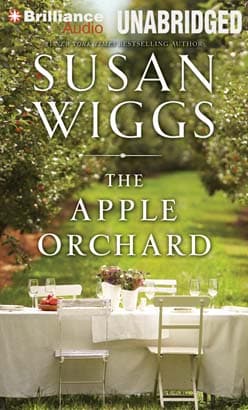

I'll be honest — I almost skipped this one. Contemporary romance set on a Sonoma apple orchard? My students would call that "Hallmark vibes" and move on. And they wouldn't be entirely wrong about the surface-level pitch. But here's the thing: Susan Wiggs is doing something sneakier than the premise suggests, and Christina Traister's narration gave me reason to stick around during a late Saturday walk along the lakefront with Denise, who kept asking why I was smiling at my phone like a fool.
Stolen Necklaces and Stolen Histories
The setup hooked me before the romance did. Tess Delaney recovers stolen art and artifacts for a living — she's basically a provenance detective. That alone would've been enough for a decent novel. But Wiggs layers in a WWII-era storyline about Nazi occupation, a hidden grandfather in a coma, and a half-sister named Isabel who inherits the other half of a hundred-acre apple estate called Bella Vista. It's a lot. Maybe too much for some readers. But Wiggs handles the dual timelines the way a good historical novelist should — the past isn't decoration, it's the engine. The necklace that opens the story isn't just a MacGuffin; it's the thematic thesis. Memories over money. Heritage over transaction. This reminds me of what Hemingway said about the dignity of movement of an iceberg — most of what matters here is beneath the surface.
The Sonoma setting could've gone saccharine fast. And sure, there are passages about warm earth and bare feet and golden light through apple trees that lean toward the postcard. But Wiggs earns those moments because Tess is a character who doesn't trust beauty. She catalogues value for a living. She knows exactly what things cost and nothing about what they're worth. Watching her learn the difference — slowly, reluctantly — that's where the real story lives.
Traister Knows When to Breathe
Christina Traister does something I notice in the best narrators: she understands that pause is punctuation. Her Tess is guarded, clipped, professional — and you hear the walls come down gradually across twelve hours. It's not a dramatic shift. It's erosion. By the midpoint, there's a warmth in her voice for Tess that wasn't there in chapter one, and I don't think it's accidental.
Her female characters are where she really shines. Isabel gets this slightly warmer, more open quality — you can hear the difference between the sisters before you even clock it consciously. The male characters are competent but less distinctive, which is pretty standard for a single female narrator handling a romance. I've heard worse. I've heard much worse. She doesn't try to go baritone and embarrass herself, which — trust me — I appreciate after some audiobooks I've suffered through.
The pacing works for driving or walking. It's a twelve-hour listen that doesn't demand your full analytical brain, but it rewards attention when you give it. I caught details about the WWII subplot — the family loss, the occupation, the choices made under impossible pressure — that hit differently because Traister doesn't rush through them. She lets the weight of those scenes sit. The prose deserves to be savored, especially in the historical passages where Wiggs is clearly writing from research she cares about.
The Romance Question (Because Yes, There Is One)
Look, I teach Brontë. I'm not above a good love story. My thoughts on what makes romantic stakes actually work are scattered throughout my review of Anna Karenina, Book 8, where Tolstoy proves that the slow unraveling of a person is always more compelling than the quick spark. The romance here is slow-burn in the best sense — it's organic to Tess's arc rather than imposed on it. She falls for someone connected to Bella Vista (of course she does), and the relationship unfolds alongside her discovery of family and place. If you loved A Year in Provence for its sense of landing somewhere and letting roots take hold, this is its spiritual successor — with more plot and fewer restaurant descriptions.
Is it predictable? Parts of it, sure. You can see certain revelations coming from a mile away. But predictability in romance isn't always a flaw — sometimes it's a promise the author makes and keeps. Wiggs keeps her promises.
Who This Is Actually For
If you want literary fiction that punishes you, keep walking. If you want a smart, warm novel that braids WWII history with contemporary family drama and doesn't insult your intelligence while also giving you a satisfying love story — this is your book. My students would hate this. I love it. It's comfort reading with actual substance underneath, and Traister's narration elevates it beyond what the page alone might deliver.
Denise, for the record, has already stolen my earbuds to start it herself. I'm choosing to take that as a compliment.
Worth Pausing the Faculty Meeting For
Not every audiobook needs to be Faulkner. Sometimes you need the literary equivalent of a good Sonoma red — something warm, layered, and better than you expected from the label. This is that. Christina Traister pours it well.