
Look, I need to confess something upfront: I'm a high school English teacher who spends most of his time convincing teenagers that Hemingway matters. So when I tell you I just spent ten hours listening to a book about a prehistoric mega-shark eating people, you should understand this represents a significant departure from my usual literary diet.
And honestly? I regret nothing.
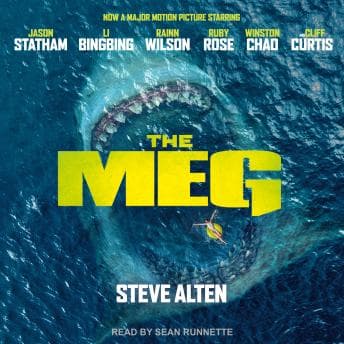
Steve Alten's Meg is not Melville. It's not even Benchley, really. But here's the thing—it knows exactly what it is. There's something almost refreshing about a book that promises you a 70-foot prehistoric shark and then delivers exactly that, with zero pretension about being anything more profound.
The Guilty Pleasure I Didn't Know I Needed
I picked this up because my wife Denise was visiting her sister, and I had a whole weekend of grading ahead of me. I needed something that wouldn't require me to pause and contemplate the human condition every five minutes. What I got was Jonas Taylor—marine paleontologist, trauma survivor, and the kind of protagonist who exists purely to give readers someone to root for while giant teeth are involved.
The premise is wonderfully absurd: a Megalodon—the prehistoric ancestor of the great white shark, basically a school bus with fins and an attitude problem—has been living in the deepest trenches of the Pacific Ocean. And now it's coming up to say hello. Alten front-loads a lot of scientific exposition (sometimes too much, I'll admit—there are info dumps here that would make my AP Lit students groan) to make the whole thing feel plausible. Does it work? Mostly. You buy into the world enough that when the shark starts doing shark things, you're invested.
The pacing drags in spots, particularly in the middle sections where Alten seems determined to teach you everything about marine biology and submersible technology. I found myself grading papers during these stretches, which—okay, that's what I was supposed to be doing anyway. But when the action kicks in? I stopped grading. The essays could wait. The Meg was hunting.
Sean Runnette Knows Exactly How Seriously to Take a Giant Shark
Runnette is a multiple AudioFile Earphones Award winner, and you can hear why. He approaches this material with exactly the right amount of seriousness—enough to sell the tension, not so much that you forget you're listening to a creature feature. His Jonas Taylor is appropriately tortured and determined, and he handles the ensemble cast with solid differentiation.
Now, I need to be honest here. Some listeners have noted pronunciation issues, particularly with consonants. I didn't find this distracting personally, but I was also listening while walking the lakefront, so ambient noise might have smoothed over any rough patches. If you're sensitive to audio clarity, maybe sample first. But Runnette's pacing is excellent—he knows when to let a tense moment breathe and when to accelerate through action sequences. That's a skill.
The bonus inclusion of Meg: Origins is a nice touch. It gives you backstory on the Meg's prehistoric existence, which is exactly the kind of nerdy addition I appreciate even while acknowledging it's completely unnecessary.
What Would Hemingway Think?
Okay, probably nothing good. But here's my defense: not every book needs to be The Old Man and the Sea. Though honestly, I've found more literary depth in unexpected places—Their Eyes Were Watching God proved that to me when I finally taught it last semester. Sometimes you need The Old Man Gets Eaten By The Sea. Alten writes accessible, propulsive thriller prose. It's not elegant, but it's effective. The dialogue can be clunky, the characters are archetypes rather than fully realized people, and the romantic subplot feels grafted on from a different book entirely.
But.
When that shark is circling? When Jonas is in his tiny submersible in the absolute darkness of the Mariana Trench? The prose disappears and you're just there, heart rate elevated, wondering how anyone survives this. That's craft, even if it's not literary craft.
My students would hate this. They'd call it "beach read garbage." (They'd be half right—it's absolutely a beach read, though I'd argue the beach might feel less appealing afterward.) But I loved the escape of it. I loved that for ten hours, I wasn't thinking about lesson plans or budget meetings or whether Principal Martinez noticed I wasn't paying attention. I was thinking about sharks.
Who Gets an A, Who Gets Excused
If you want literary merit, look elsewhere. But if you want to be genuinely entertained and occasionally terrified while doing mindless tasks—grading, walking, folding laundry—this delivers. Skip it if clunky dialogue and thin characterization genuinely bother you, or if you need your thrillers to have something to say. Runnette's narration elevates material that could have felt cheesy in lesser hands.
Would I listen again? Probably not—it's not that kind of book. But I'm glad I took the detour from the canon. Just maybe don't listen at the beach. Or in the bathtub. Trust me on this one.