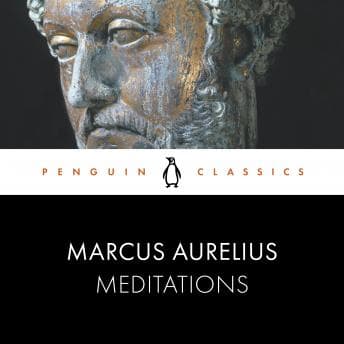

I was standing at my kitchen counter at 10 PM, halfway through a chicken tikka masala that was going to be either brilliant or a disaster - the kind of evening where you're too tired to read but too wired to sleep. So I put on Marcus Aurelius. Because nothing pairs with cumin and existential restlessness like a dead Roman emperor telling you to stop caring what people think.
Here's what struck me immediately: the Meditations aren't a book. Not really. They're a private journal. Marcus Aurelius never intended for anyone to read these. And that distinction matters psychologically, because it means you're not getting a performance of wisdom - you're getting the raw cognitive behavioral therapy a man was doing on himself while running an empire and fighting wars along the Danube. My therapist would have thoughts about this character. Specifically, she'd probably say he was doing her job two thousand years early.
A Roman Emperor on His Own Couch
What makes Aurelius compelling as a psychological subject is how repetitive he is. He circles back to the same anxieties over and over: the fear of wasting time, the irritation at difficult people, the terror of his own mortality. If this were a patient's journal, I'd see classic rumination patterns combined with active cognitive reframing. "Say to yourself at the start of the day, I shall meet with meddling, ungrateful, violent, treacherous people" - that's not pessimism, that's an exposure therapy technique. He's inoculating himself against emotional reactivity.
The research actually shows that this kind of anticipatory coping - mentally rehearsing difficult scenarios - reduces anxiety responses. Aurelius figured this out by himself, in a tent, probably cold, definitely stressed. The man was essentially writing his own CBT workbook.
What I found myself asking: why does Marcus keep returning to the image of time as a river, of all human achievements dissolving into nothing? It's not nihilism. It's the opposite. He's using impermanence as a pressure release valve. If nothing lasts, then the embarrassment from that Senate meeting doesn't matter either. I saw a similar psychological framework at work in Sailing Alone Around the World, where Slocum's isolation forced the same kind of radical self-confrontation. That's genuinely sophisticated emotional regulation for any century, let alone the second one.
Richard Armitage and the V Problem
So. The narration. Richard Armitage has this gorgeous, deep, authoritative voice that - and I mean this - does suit the material. There's a gravity to his delivery that makes these philosophical aphorisms land with weight rather than floating past you as fortune-cookie wisdom. When he reads the passages about death and decay, his tone drops into something genuinely somber. You feel the melancholy of a man who's watching friends die and provinces burn.
But there's a thing. And once you hear it, you can't unhear it.
Armitage consistently pronounces words with 'v' as 'w.' "Vexed" becomes "wexed." It's a specific vocal quirk, and some listeners will barely notice while others will find it genuinely distracting. I landed somewhere in the middle - it pulled me out of the text maybe a half-dozen times, which over six hours isn't catastrophic but isn't nothing either. There are also occasional mic pops from exhaled breath, the kind of audio artifacts that suggest the recording environment wasn't as controlled as you'd want from a Penguin Classics production. It's not amateur hour, but it's not pristine.
At 6 hours and 20 minutes, the length is right. The Meditations aren't long, and Martin Hammond's translation reads clean and modern without losing the weight of the original Greek. The introduction by Diskin Clay is useful context if you're coming to Stoicism fresh - though honestly, Aurelius is probably the most accessible entry point into this philosophy precisely because he wasn't writing for an audience.
Who This Is Really For (and Who Should Look Elsewhere)
If you've read Ryan Holiday or any modern Stoicism content and want the actual source material - yes. Get this. But know that you need to listen actively. This isn't narrative; there's no plot pulling you forward. It's a man arguing with himself across twelve books of private notes. Put this on during a commute and you'll zone out by minute fifteen. Put it on during a quiet evening when your brain is ready to actually sit with an idea? Different experience entirely.
If mispronunciation is the kind of thing that ruins audio for you, check a sample first. I'm serious. The v-to-w substitution is consistent enough that it'll either bother you or it won't, and you should know which camp you're in before committing a credit.
The Session Notes
This is a fascinating case study in a mind trying to heal itself through writing. Marcus Aurelius wasn't a philosopher by profession - he was a politician, a general, a father who buried most of his children. The Meditations are what happened when a deeply anxious, deeply conscientious person tried to build a framework for surviving his own life. Armitage's narration mostly serves that intimacy well, audio quirks aside. I finished my tikka masala (it was brilliant, thanks for asking) and sat with it for a while. Which is probably what Marcus would've wanted, if he'd wanted anything from us at all.