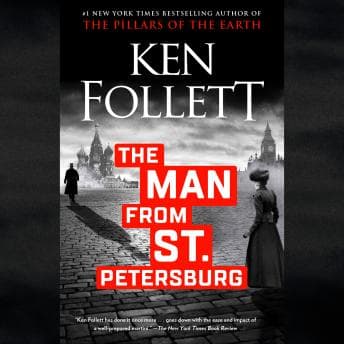

What makes a man cross a continent to kill a stranger?
That's the question Ken Follett drops in your lap within the first hour of The Man from St. Petersburg, and it's the question I kept turning over during a late-night cooking session — lamb rogan josh, if you're curious, the kind of dish that requires enough stirring to keep your hands busy but leaves your brain entirely free to obsess over fictional anarchists.
Feliks Kschessinsky is a fascinating case study in ideological commitment versus human connection. He arrives in 1914 London with one job: assassinate a Russian prince to derail an Anglo-Russian military alliance. Simple enough on paper. But Follett doesn't give us a cardboard cutout assassin. Feliks has history — with a woman now married into the English aristocracy, with a daughter who doesn't know he exists, with a revolutionary movement that has already consumed everything soft in him. The protagonist exhibits classic cognitive dissonance: he genuinely believes his mission serves humanity while systematically destroying the humans closest to him. That's not a contradiction Follett stumbles into. He understands it.
The Psychology of Conviction (And Its Casualties)
What makes this character compelling is that Feliks isn't wrong, exactly. The coming war will kill millions. His logic — kill one man to prevent the alliance, prevent the slaughter — has a cold mathematical clarity. But Follett layers in the personal stakes so carefully that you start watching Feliks's ideology crack against his own humanity, and that's where the real tension lives. Not in the chase scenes (though there are plenty), but in the moments where Feliks has to choose between the cause and the person standing in front of him.
The English lord, Walden, is equally well-drawn. He's not a villain. He's a man defending his world — his family, his class, his country's strategic interests — with the same conviction Feliks brings to tearing it all down. I found myself asking: why does Walden really pursue Feliks so relentlessly? Is it patriotism, or is it the terrifying suspicion that his wife's past might unravel his entire constructed life?
Now. The women. Here's where I have to be honest, and where some listeners have flagged a legitimate issue. The female characters — Walden's wife Lydia and their daughter Charlotte — are written with a certain... 1982 sensibility. Lydia is practically defined by her sexual history and the shame surrounding it. Charlotte's awakening is interesting in theory (young aristocratic girl radicalized by poverty she's never witnessed), but Follett handles her with the subtlety of a man who thinks female rebellion is primarily about discovering desire. Psychologically, this doesn't track — not because women don't experience political awakening through the body, but because Charlotte's arc feels instrumentalized. She exists to complicate Feliks's mission, not to be a person. My therapist would have thoughts about how Charlotte's agency gets framed as naivety rather than genuine conviction.
Is the material dated? Parts of it, yes. Can you still get something from it? Absolutely — if you're willing to read the gender politics as a product of its era rather than an endorsement.
Richard Armitage Could Narrate My Grocery List
I don't say this lightly, because I'm generally suspicious of narrator hype. But Richard Armitage's baritone does something specific here that elevated my experience considerably. His vocal shift between Feliks and Walden creates an instant class and cultural divide — the slight roughness he brings to Feliks's speech versus the clipped precision of Walden's aristocratic English. You hear the ideology in the voice before the words even register. That's not just good acting, that's someone who understood the character psychology.
One listener literally said they continued the novel just to hear his voice, and — okay, I get it. There were stretches in the middle where Follett's plotting gets repetitive (Feliks attempts murder, fails, escapes, attempts again, fails, escapes), and Armitage's performance is genuinely what kept me stirring that rogan josh instead of switching to a podcast.
Who Gets the Most Out of This
If you're a reader who loves the intersection of personal drama and political machination — the way individual choices ripple into historical consequence — this is your book. If you need female characters written with the same psychological depth as the men, you're going to be frustrated. If you love spy thrillers set in Edwardian London with a Russian anarchist protagonist and you want someone with a phenomenal voice reading it to you, I mean — the Venn diagram of that audience and people who will love this is a circle.
The pacing sags in the middle third. There are passages that feel like Follett padding his word count with repetitive cat-and-mouse sequences. I ran into a similar pacing problem with Tales of Terror and Mystery, where strong individual setups couldn't quite sustain the momentum across a longer runtime. At 12 hours and 41 minutes, this could've been tighter at 10. But the setup is strong, the finale delivers, and the moral ambiguity stays with you.
My Case Notes
This is a book about people who are absolutely certain they're right, and how that certainty makes them both heroic and monstrous. Follett wrote it in 1982 and some seams show. But the central question — what are you willing to destroy for what you believe? — never gets old. Armitage's performance papers over the weaker stretches and genuinely enhances the stronger ones. Worth your time, especially on a long drive or a slow evening with something simmering on the stove.