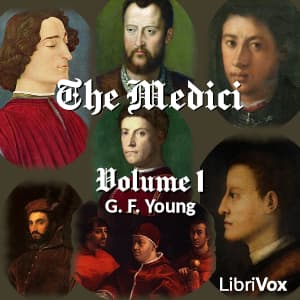

Everyone talks about LibriVox like it's some noble sacrifice - "free audiobooks, how generous!" - but let me tell you what fifteen hours with volunteer readers actually feels like.
It feels like sitting in your abuela's living room while different relatives take turns reading from the same book. Some of them have beautiful voices that make you lean in. Others sound like they're reading their grocery list. And you love them all anyway, because they're trying, and because the story itself is worth the occasional stumble.
I was deep into a branding project for a client - one of those marathon sessions where Frida judges me from the windowsill and Diego has claimed my lap as his personal throne - when the Pazzi conspiracy section came on. An assassination attempt. During Easter Mass. In the Florence Cathedral. With swords hidden under robes and a pope's nephew orchestrating the whole thing. I literally paused my design work and just... listened. Because WHAT.
Wool Merchants to World-Shapers
G.F. Young wrote this in the 1890s, and the prose reflects that era completely. Dense. Formal. The kind of writing that assumes you already know what a "condottiero" is and won't stop to explain. For the first two hours, I'll be honest - I almost gave up. The setup felt like wading through academic quicksand.
But then something shifted. Maybe I adjusted to the rhythm. Maybe the Medici themselves just got more interesting as they accumulated power. Cosimo de' Medici never held an official title, never wore a crown, but controlled Florence like a puppet master working invisible strings. He'd exile his enemies, fund churches, bankroll artists - all while maintaining this facade of being just another citizen. The audacity! The calculation!
And Lorenzo the Magnificent? My heart. MY HEART. Here's a man who turned Florence into the beating heart of the Renaissance, who protected Botticelli and Michelangelo, who wrote poetry and threw festivals and basically invented the concept of cultural soft power. Watching his descendants slowly squander that legacy across the following generations felt like watching a slow-motion tragedy. You know it's coming - this is 500-year-old history - but it still hurts.
The Rotating Cast Problem
Let's talk about the elephant in the room. LibriVox means multiple volunteer narrators, and the quality varies wildly. One chapter might have someone with a warm, steady delivery who makes the political intrigue feel almost intimate. The next chapter might sound like someone reading aloud for the first time, stumbling over Italian names and losing the thread of complex sentences. I hit the same roulette wheel of narration quality in History of the Decline and Fall of the Roman Empire Vol. V — another LibriVox marathon where the gap between the best and worst readers is genuinely staggering.
I can't tell you there's a standout performer because the transitions happen without warning. What I CAN tell you is that the uneven quality becomes almost charming after a while - like those old radio dramas where production values were secondary to storytelling. The readers are clearly passionate about the material. You can hear it in how they emphasize certain passages, how they slow down for the dramatic moments.
But if you're someone who needs polish, who can't tolerate amateur production... this will drive you up the wall. No sugarcoating that.
When History Reads Like a Telenovela
Abuela would have been OBSESSED with this book. The scheming! The betrayals! The way power corrupts across generations! It's basically a telenovela stretched across three centuries, except every ridiculous plot twist actually happened.
The Pazzi conspiracy alone - I keep coming back to it because it's so wildly dramatic - involves a rival banking family, a frustrated pope, a plan to murder Lorenzo and his brother during the holiest moment of the Easter service. They succeed in killing Giuliano. They fail with Lorenzo. And the aftermath? Public hangings. Bodies dragged through the streets. Revenge that echoes for decades.
Young connects all of this to the art, which is what elevates the book beyond dry political history. You understand WHY the Renaissance happened in Florence specifically. The Medici weren't just patrons - they were creating a cultural legacy that would outlast their political power. Every commissioned painting, every funded sculptor, every philosopher they protected was an investment in immortality.
Who This Is (and Isn't) For
This is a fifteen-hour commitment with uneven narration and nineteenth-century prose. You need to want it.
If you already care about the Renaissance - if Brunelleschi's dome makes you emotional, if you've stood in front of a Botticelli and felt something shift in your chest - this book will feel like coming home. Young assumes you're already invested, and he rewards that investment with depth and detail that modern pop-history books often skim over.
If you're looking for an accessible introduction? Start somewhere else. A documentary. A newer biography. Something with a narrator who can carry you through the dense parts.
But if you want to live with the Medici for a while, to let their story become background music for your life over a week or two? This works. I designed three logos, cooked approximately twelve meals, and fell asleep to Renaissance intrigue more nights than I can count. The book became a companion.
Abuela Would Have Gasped
It's free. It's imperfect. It's the kind of audiobook that rewards patience and punishes impatience in equal measure.
I found myself googling paintings at 2 AM, falling down Wikipedia holes about the Pazzi family, looking up images of the Duomo and trying to imagine swords flashing during Easter Mass. That's what good history does - it makes you curious beyond its own pages.
Proposed Roads to Freedom did the same thing to me — a LibriVox recording that sent me down a completely different kind of research spiral at an equally unreasonable hour.Abuela would have clutched her rosary at the violence and demanded I tell her more about Lorenzo. She always loved the ones who burned too bright.
Miss you, Abuela. This one's for you.





![Steve Jobs [unabridged audiobook] audiobook cover](/_next/image?url=https%3A%2F%2Fcovers.audiobooks.com%2Fimages%2Fcovers%2Ffull%2F9788499923406.jpg&w=1920&q=75)