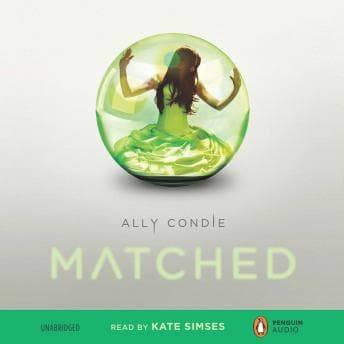

So here's the thing about dystopian YA that I find endlessly fascinating from a psychological perspective: the Society in Matched isn't just controlling who you marry. It's controlling the entire architecture of desire. And honestly? That's way more insidious than any Hunger Games arena.
I listened to this during my morning jogs through Cambridge, and there's something almost poetic about running past Harvard while hearing about a world where the government decides everything for you. The irony wasn't lost on me.
The Psychology of Choice (Or Lack Thereof)
What Ally Condie understands—and what I wish more dystopian authors would grasp—is that oppression doesn't always look like violence. Sometimes it looks like comfort. The Society gives Cassia everything: optimal nutrition, guaranteed employment, a statistically perfect match. The protagonist exhibits classic cognitive dissonance when that system cracks. She's been told her whole life that the Officials know best, and then boom—two faces on a screen instead of one.
This is a fascinating case study in how identity forms under total control. Cassia doesn't know who she is because she's never had to choose. The research actually shows that our sense of self is literally constructed through decision-making. Take that away and what's left? A shell waiting to be filled.
It's the same principle explored in Power of Concentration—how our mental habits shape who we become, except Cassia doesn't even get to form those habits on her own terms.
(My therapist would have thoughts about this character. Many thoughts.)
The love triangle here isn't really about romance—it's about autonomy. Xander represents the safe choice, the sanctioned path. Ky represents the terrifying freedom of wanting something the system didn't assign you. Condie gets this. Rebellion rarely starts with grand gestures. It starts with a feeling you can't explain.
Kate Simses and the Art of Restraint
Kate Simses has this feathery, clear quality to her voice that initially made me skeptical. Would it work for dystopia? But here's where I was wrong—it's perfect for Cassia specifically. This is a girl who's been raised to be smooth, compliant, pleasant. The narration mirrors the Society's conditioning.
Simses nails the emotional delivery when Cassia starts questioning things. There's a subtle shift—not dramatic, not over-the-top—just this gradual awakening in the voice. She differentiates between Xander and Ky effectively, giving each their own texture without going full voice-actor-mode. It works.
Some listeners apparently found her an inappropriate choice, and I get it. If you're expecting gritty dystopia narration, this isn't that. But psychologically? The youthful, almost innocent quality makes Cassia's awakening hit harder. You're hearing her lose something as she gains awareness.
The 9+ hour runtime flew by during my runs. Didn't zone out once, which is saying something for a slower-paced book.
Where the Narrative Drags (And Why That's Okay)
Look, I won't pretend this is action-packed. It's not. The pacing is deliberate—some would say slow. Cassia spends a lot of time thinking, questioning, sorting through her feelings. If you need constant plot movement, you'll be frustrated.
But here's my take: the slow burn is the point. Condie is showing us how hard it is to unlearn everything you've been taught. Real psychological change doesn't happen in dramatic montages. It's messy and gradual and full of backsliding. Cassia doesn't suddenly become a revolutionary. She becomes curious. That's more realistic.
The poetry element—Cassia's grandfather leaves her forbidden poems—is a nice touch. Words as rebellion. The idea that art itself is dangerous because it makes people feel things the Society can't control. (I found myself asking: why does the Society fear poetry specifically? Because it teaches you that your emotions are valid. Powerful stuff.)
There's something here about how we validate our own experiences through language—reminds me of the framework in Game of Life and How to Play It, where naming your reality becomes the first step toward changing it.
Who This Works For (And Who It Won't)
Ideal for teenage listeners, ages 10-14ish, who are starting to question authority for the first time. Also great for adults who appreciate character-driven stories and don't need explosions every chapter. Perfect commute material—engaging enough to keep you alert, not so complex you'll miss crucial details if someone honks.
Skip if you want intense dystopia with high stakes and constant danger. This is quieter than that. More internal. If you're expecting The Hunger Games energy, you'll be disappointed. Also worth noting: this is book one of a trilogy. It ends with questions, not answers. If that bothers you, maybe wait until you can listen to all three.
The Psychologist's Take
I came to Matched as a psychologist and left genuinely impressed by how Condie handles the construction of identity under totalitarian systems. It's not perfect—some of the worldbuilding feels underdeveloped, and I wanted more about how the Society actually functions—but as a character study? Solid work.
Kate Simses delivers exactly what this story needs. Clean production, no audio issues, just a clear voice guiding you through Cassia's awakening.
Would I listen to the sequels? Yeah, actually. I want to see where Cassia's psychology goes from here. And honestly, that's the best compliment I can give a YA dystopia.