
What happens to your need for affection when your skin makes affection dangerous? I was sitting on my apartment floor, sorting old art-school prints into keep and recycle piles, when Juliette’s hunger for human contact made the whole task feel ridiculous. Here I was deciding which imperfect things deserved saving, listening to a girl who has been taught to think of herself as something people should throw away. The prints stayed scattered longer than planned.
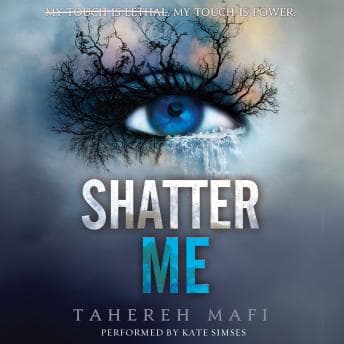
That’s the part of Shatter Me that got under my ribs. Not the threat of a deadly touch by itself, but the loneliness attached to it. Tahereh Mafi makes wanting closeness feel physically hazardous. I bought that ache much more readily than I bought every romantic beat or every elaborate metaphor wrapped around it.
Her skin is dangerous; her loneliness did the damage
Juliette Ferrars can hurt or kill someone through touch, and the Reestablishment sees a potential weapon where she sees a curse. That opposition gives the book its sharpest emotional question: if people only value what your body can do for them, how do you start believing you’re a person rather than a resource?
Oof. That was enough to keep me listening even when the prose started decorating feelings I already understood.
Mafi’s writing is intensely interior, full of repetition, imagery, and thoughts Juliette tries to retract. The strikethrough passages matter because they reveal the distance between what she feels and what she permits herself to admit. Those mental corrections interested me more than the broader dystopian machinery. The Reestablishment supplies the threat; Juliette’s habit of arguing against her own feelings supplies the intimacy.
The reunion with someone who cared about her gives the romance an immediate emotional advantage: being remembered is a potent thing when you’ve been treated as untouchable. I understood why that connection mattered before I was completely sold on the chemistry. There’s a difference. Sometimes I felt Juliette’s desperation for tenderness more strongly than I felt the particular relationship earning its intensity.
And yes, the metaphor-heavy writing occasionally wore me out. I enjoy heightened emotion—I was raised on television romances in which a doorway could hold three separate betrayals—but some passages keep intensifying after the feeling has already landed. The premise promises danger; the listening experience often asks you to stay inside the anticipation of danger instead. Expect emotional circling, not nine hours of forward charge.
Kate Simses makes the crossed-out thoughts worth hearing
The strongest case for choosing audio is Kate Simses’s handling of Juliette’s inner voice. Her delivery is soft and clear, with a thin, almost glassy edge of youth. That sound makes Juliette’s vulnerability immediate, though I understand why some listeners hear it as too childlike. It can make an already fragile character sound smaller still.
For me, the inflection usually kept that softness from becoming blankness. Especially with those retracted thoughts: Simses helps you hear the feeling beneath Juliette’s attempt to take it back. You don’t have the visual strike across the words, so the emotional distinction has to reach your ear. Those passages were where I most appreciated having a performer between me and the page. Simses has more range than this role lets her show—her narration of Night Divided is steadier and more commanding, and I kept wishing a little of that register had snuck in here.
I’m less enthusiastic about the male dialogue when emotions run high. The vocal distinctions aren’t consistently strong enough, and some voices sit too close together. Juliette’s interior passages have a more convincing emotional texture than the most heated exchanges. If romantic tension depends on the sound of a male lead’s voice for you, adjust your expectations. For contrast, Lorelei King's work on Ten Big Ones keeps an entire cast of slightly ridiculous Trenton regulars instantly separable—same one-narrator setup, completely different effect.
The recording itself stays clean, without background noise or distracting volume shifts. I listened at 1.0x; the pauses belong to Juliette’s hesitant, self-correcting thought patterns. Speeding through them would address the runtime without necessarily solving what makes the pacing feel slow.
Keep Juliette; sample the metaphors first
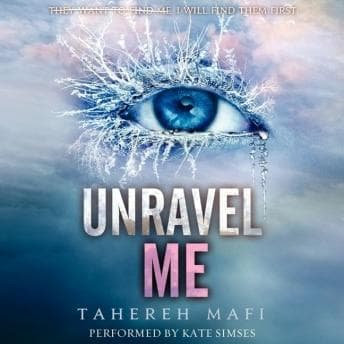
You should try this if you want a touch-starved heroine’s emotional awakening and can accept familiar dystopian scaffolding around it. You’re getting close access to Juliette’s frightened, contradictory mind, not an equally detailed examination of the regime threatening her. Mafi doubles down on that interiority in the sequel, Unravel Me—the regime stays blurry there too, while the feelings get even louder.
You should pass if ornate prose makes you impatient, or if you need crisp action and reliably differentiated male voices. Simses supports the book’s vulnerability better than its confrontations. Also, despite the Kids & Family category attached to this listing, I’d treat it as YA: violence, abuse, language, and sexual content deserve consideration before handing it to a younger listener.
My recommendation is to sample first and buy on sale if Juliette’s voice catches you. Across 9 hours and 13 minutes, I found enough tenderness to care, but enough repetition to hesitate over a full-price credit. The crossed-out thoughts stayed with me. Some of the words surrounding them could’ve gone in my recycle pile.