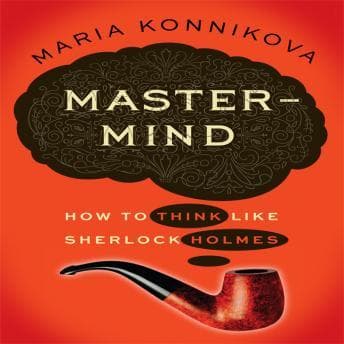

I was halfway through my morning jog along the Charles River when Maria Konnikova started explaining Holmes's 'brain attic' concept, and I literally stopped running. Just stood there on the path like a weirdo while cyclists swerved around me. Because here's the thing—I've been teaching cognitive psychology for years, and I'd never heard anyone frame selective attention quite that elegantly.
So yes. I have feelings about this book.
When Psychology Meets the World's Most Famous Detective
Konnikova does something genuinely clever here. She takes Sherlock Holmes—a character I've analyzed in probably too many dinner party conversations—and uses him as a framework for understanding how our minds actually work. Holmes exhibits classic metacognitive awareness, but what makes this compelling is that Konnikova doesn't just say 'be more observant.' She breaks down the neuroscience of why we miss things, why our brains take shortcuts, and how we can train ourselves to notice more.
The research shows that mindfulness and deliberate attention can be cultivated. This isn't news to anyone in my field. But Konnikova makes it accessible in a way that most academic papers (including, let's be honest, my own) absolutely do not. She pulls from the Holmes canon strategically, using specific passages to illustrate cognitive biases and mental models.
That said—and this is where I found myself getting a bit frustrated—she repeats some of those Holmes passages. Multiple times. I get the pedagogical reasoning. Repetition aids retention. But by the third time I heard the same quote about observation versus seeing, I was ready to move on. The research shows that spaced repetition works, Maria. *Spaced.* Not back-to-back.
Karen Saltus: Clear Delivery, Complicated Tone
Karen Saltus has a clear, professional delivery. Her enunciation is precise. Her pacing is consistent. And yet.
I couldn't find much about Saltus online beyond this audiobook, but based on this performance—there's a tone issue. It's subtle at first, but after a few hours, the delivery starts to feel a bit... lecturing? Like she's explaining something to someone she doesn't quite trust to understand it. The irony of a book about cultivating better observation being delivered in a way that made me want to tune out was not lost on me.
I ended up speeding it up to 1.25x, which actually helped. The faster pace smoothed out some of that condescension and made the information feel more conversational. Your mileage may vary, but it worked for me.
The production quality itself is clean—no weird background noises, no volume issues. Just that monotone delivery that some listeners will find soothing and others (me, apparently) will find slightly grating.
Who Should Queue This Up (And Who Should Skip)
If you're a Holmes aficionado who also happens to be curious about cognitive science? This is genuinely a fascinating case study in how fiction can illuminate real psychological principles. Konnikova clearly loves both subjects, and that enthusiasm comes through even when the narration doesn't quite match it.
If you're already well-versed in popular psychology—if you've read Kahneman, Ariely, the usual suspects—you might find some of this familiar. The concepts aren't groundbreaking for anyone who's been paying attention to the field. But the Holmes framing gives it a fresh angle, and there are enough specific, practical strategies to make it worthwhile.
If you're sensitive to narration tone, though? This might not be your best listening experience. The content is solid, but you might want to grab the print version instead.
I found myself asking: why does this book work despite its flaws? I think it's because Konnikova genuinely understands human nature—both Holmes's fictional version and our messy, distractible, shortcut-taking real one. She meets readers where they are instead of where she wishes they were. That's rarer than it should be in self-help. Awaken the Giant Within takes a more aggressive approach to that same transformation work, though I found Konnikova's gentler framing easier to actually implement.
The book is best consumed during activities that don't require your full attention—commutes, cooking, folding laundry. It's educational without being dense, which makes it perfect background listening when you want to feel like you're improving yourself but also need to remember to add cumin to the dal.
My Professional Opinion (For What It's Worth)
Would I listen again? Probably not. But I'm genuinely glad I listened once. And I've already recommended it to three students who keep asking me how to 'think better.' This is a pretty good starting point. Though honestly, Girl, Stop Apologizing might work better for the ones who need more motivational energy than cognitive frameworks. Just maybe bump up that playback speed.