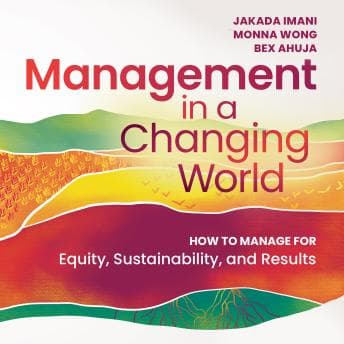

Look, I'll be honest—when I saw "equity, sustainability, and results" in the same subtitle, my McKinsey-trained skepticism kicked in hard. Usually that's code for "we're going to talk about feelings for 8 hours and give you zero actionable frameworks." I've sat through enough nonprofit board meetings to know the type.
I was wrong. And I don't say that often.
Finally, Someone Bridges the Gap
Here's what got me: Imani, Wong, and Ahuja actually understand that caring about your team AND getting results aren't opposing forces. This is what my parents did instinctively—they ran that dry cleaning shop with fierce loyalty to their employees while still making payroll every single week. Now it has a TED talk. Or in this case, a 9-hour audiobook.
The "conspire and align" framework they lay out? I've seen the opposite—command and control—fail at three different companies. One was a social enterprise that couldn't retain anyone under 35. Another was a nonprofit where the ED wondered why staff kept "quiet quitting." The answer was always the same: people don't want to be managed AT, they want to be managed WITH.
The book delivers actual tools. Delegation frameworks that account for power dynamics. Goal-setting that doesn't pretend everyone starts from the same place. And—this is rare—honest talk about what happens when your good intentions crash into messy reality. Most management books skip that part. These authors don't. The practical honesty here reminded me of Debt-Free Spending Plan—another book that refuses to pretend implementation is easy.
Cindy Kay Keeps It Clean
The narration is professional. Nothing flashy, but that's actually right for this material. You don't need dramatic flair when someone's explaining how to have a difficult conversation with a direct report. You need clarity. She delivers that.
I listened at 1.5x (yeah, I dialed it down from my usual 2.0x) because some of the concepts actually required processing time. That's a compliment. When I can blast through at double speed, it usually means there's not much there. This one made me slow down and think.
The pacing is steady—maybe a touch slow in the early chapters where they're establishing their philosophy. Skip to chapter 3 if you want to get to the practical stuff faster. Thank me later. But honestly? The philosophical grounding pays off when you hit the harder tactical sections.
Who Needs This (And Who Doesn't)
If you're managing humans in a mission-driven organization and you're tired of pretending traditional corporate management translates directly to nonprofit work, this is your book. It doesn't translate. The power dynamics are different. The resources are different. The burnout patterns are different.
The authors get this because they've lived it. They're not consultants parachuting in with McKinsey frameworks (I can say that, I was one). They're practitioners who've built teams, lost people, made mistakes, and figured out what actually works.
Skip it if: you're running a traditional corporate team with standard hierarchies and resources. Some sections assume nonprofit-specific context that won't translate.
Jenny would say I'm being harsh on traditional management books. Jenny is right. But she'd also agree this one earned its runtime.
The key takeaway is worth the listen—managing for equity isn't about lowering standards, it's about raising your awareness of context. The other 6 hours? Actually also worth it, which is not something I say often. There's maybe an hour of repetition you could trim, but for a 9-hour business book, that's pretty efficient.
Would I recommend this to the startup founders I work with? Already did. Sent it to three of them last week. The ones building diverse teams and wondering why their Silicon Valley management playbooks aren't working? This is the answer they didn't know they needed.
The ROI Calculation
Grab it. Listen at 1.25x if you're impatient. Take notes. Your team will thank you.