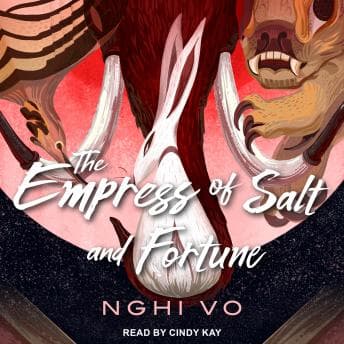

Two hours and twenty-five minutes. That's it. That's the whole book.
And honestly? It wrecked me harder than some 40-hour epics I've powered through this year. I finished Empress of Salt and Fortune while sitting on my apartment floor at 1 AM, surrounded by a half-assembled game of Gloomhaven that I'd completely forgotten about, just staring at my phone like Rabbit had personally reached through the speaker and grabbed me by the shirt.
A Story Told Through Objects Left Behind
Here's the thing about Nghi Vo's approach that I can't stop thinking about - the entire story is structured as an inventory. A cleric named Chih visits a lake house, and Rabbit, an old handmaiden, tells them the story of Empress In-yo through the objects they find there. A comb. Letters. A pouch of tea. Each item unlocks a piece of political history, a memory of rebellion, a quiet act of fury disguised as obedience.
It's like if someone ran a D&D campaign where the entire plot was revealed through Investigate checks on mundane items in a single room. And somehow it works brilliantly. The framing device - Rabbit narrating to Chih while they catalog these artifacts - gives the whole novella this recursive storytelling quality. You're listening to someone listen to a story. It shouldn't be this effective, but the layering makes every revelation land twice.
The world-building is condensed but dense. War mammoths from the north. Mage-enforced exile disguised as a summer retreat. A political marriage that's really a cage. Vo gives you just enough to feel the weight of this empire without ever stopping to explain its tax system. (I respect a good info-dump, you know this about me, but Vo proves you can also build a world through implication and it hits just as hard.)
Cindy Kay and the Art of the Whisper
Okay, so - Cindy Kay. Her narration has this almost-whispering quality, like someone telling you a secret they've been holding for decades. It fits perfectly. This IS a secret being told. Rabbit is confessing a life's worth of quiet revolution to this young cleric, and Kay's delivery makes you feel like you're eavesdropping on something sacred.
But I gotta be honest: the character differentiation is thin. When Rabbit speaks versus when she's quoting In-yo versus when she's recounting what the emperor said - it can blur together. In a book with this many political players, I occasionally lost track of who was speaking. Steven Pacey this is not. (Steven Pacey walked so other narrators could run, but Kay is doing something different here - she's not trying to perform a cast, she's channeling a single storyteller's memory, and that choice mostly works.)
The tone she sets is what carries it. There's a warmth that makes the whole thing feel like your grandmother is telling you the real history they don't put in books, leaning close so no one else hears. When the story turns dark - and it does, quietly, the way a knife slides between ribs - Kay doesn't raise her voice. She gets quieter. That restraint is genuinely effective.
Tiny Book, Massive Rage
What got me is how angry this book is underneath its elegance. In-yo is shipped south as a political hostage, essentially. Her people lost. Her mammoths are penned up. She's married to a man who doesn't care about her. And the story of how she dismantles the people who put her in that position - piece by piece, object by object, ally by carefully chosen ally - is so satisfying it practically has a progression system. Each chapter is a level-up in a revenge build that takes decades to pay off.
The feminist angle isn't subtle, but it's not preachy either. It's just... true. The women in this story survive by being underestimated, by weaponizing the roles they're forced into. Rabbit was sold by her parents for five baskets of dye. In-yo was sold for a peace treaty. Neither of them stays bought.
My D&D group would love this - it's basically the backstory for the most terrifying NPC your DM ever created, the one who smiles politely while toppling kingdoms.
Who Gets This and Who Bounces
If you need action sequences and explicit magic systems, this isn't your book. There's no Sanderson-level hard magic here - the magic exists at the edges, in the mammoths and the mages, but Vo isn't interested in explaining how it works. She's interested in who it serves and who it crushes. That folktale-as-weapon quality actually reminded me of Kipling's narrative approach in Complete Just So Stories — obviously a wildly different context, but that same sense of stories encoding power structures beneath a deceptively simple surface.
If you love political fantasy, stories-within-stories, or anything that feels like a folktale with teeth - grab this immediately. At under two and a half hours, it's basically a long commute. I read this instead of writing my thesis, and it took less time than most of my procrastination sessions.
Worth the Credit for a Novella?
Here's my only real hesitation: the length-to-price ratio. Two and a half hours is short for an audiobook credit. The experience is worth it - but if you've got a library card and Libby on your phone, maybe start there. If you love it (you will), then buy the whole Singing Hills Cycle and settle in. This is a series starter that's all setup and still completely satisfying on its own. That's rare.