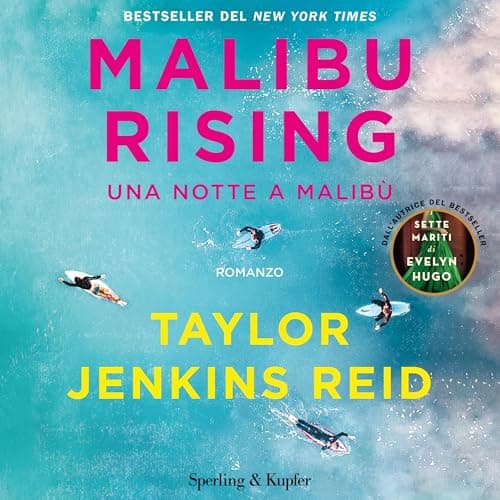

"Abbandonati a sé stessi" — abandoned to themselves. That phrase hit me somewhere around hour three, and I had to pause the audiobook right there on the bench outside the community center, Luna nudging my hand like she does when she senses something shifting in me. Because that's what this book is really about, underneath all the Malibu glitter and the party and the celebrity nonsense. Four kids, abandoned by both parents in different ways, building each other into a family because no one else was going to do it for them.
Chosen family isn't a trope — it's survival. And Taylor Jenkins Reid gets that here. She genuinely gets it.
The Riva Kids Feel Like My Kids
Look, I work with teenagers who've had to become their own parents. Who've had to raise siblings while the adults in their lives chased their own chaos. So when Nina Riva is simultaneously falling apart from her divorce and holding the entire family together — throwing the party she hates because that's what everyone expects — I felt that in my chest. That's not a character archetype. That's a specific kind of exhaustion I see in my office every single week.
What Reid does well is she doesn't let any of the four Riva siblings be simple. Jay's golden-boy surfer thing is covering something. Hud's secret — the thing he has to confess to his brother at this party — carries real weight because you feel the years of closeness that confession threatens to destroy. And Kit, the youngest, the one still figuring out who she is and who she wants — my clients would feel seen by Kit in particular. She's not written as a punchline or as the baby of the family. She's written as someone choosing her own path while terrified of losing the only people who've ever stayed.
The 1950s flashbacks to Mick and June's story — the parents' origin — are where the book earns its emotional thesis. You watch the abandonment happen in slow motion across decades. You understand exactly how these kids ended up parenting themselves. It's painful in a way that doesn't feel exploitative.
The Audio Format Complicates Things (And Not Always in a Good Way)
Here's where I have to be honest. This is an Italian-language narration by Eleni Molos, and Molos does solid work — her voice has warmth, and she handles the emotional beats with care. But the timeline jumping that Reid loves? It's harder to track in audio than on the page. The story weaves between the 1950s origin story, the buildup to the 1983 party, and the party night itself, and there are moments — especially in the middle hours — where I lost my footing on which era I was in.
One listener put it perfectly: "it was really hard for me to remember who they were or why they were important when the narration was going around so much." That tracks with my experience. I listen at 1.25x because I need to catch every emotional beat, and even at that speed, the character introductions during the party chapters felt crowded. There are a LOT of secondary characters who show up for the party, and in audio, without the visual cue of a chapter heading or a name on the page, they blur together.
Molos doesn't get in the way — she's competent and present — but the narration doesn't do the heavy lifting needed to distinguish between the rotating perspectives. In a book with this many voices, you almost need a full cast, or at least more dramatic vocal shifts between characters. The Harry Potter and the Sorcerer's Stone (Full-Cast Edition) is exactly the kind of production I kept wishing for here — hearing what it sounds like when a sprawling ensemble actually gets the full-cast treatment makes you realize how much the single-narrator format leaves on the table.
Queer Joy AND Queer Pain — Both Matter
I won't spoil Kit's storyline, but I will say this: the way Reid handles Kit's arc felt authentic to me. Not sanitized for straight readers. Not performed. It felt like a young person figuring things out in real time, surrounded by people she loves and is terrified of disappointing. The representation done right for once — or at least close to right. It's not the center of the novel, which some readers might want, but its placement feels organic rather than token.
The book also doesn't shy away from the ugly stuff — Mick Riva is a terrible father who weaponizes charm, there's alcoholism and neglect and the specific kind of damage that happens when a parent chooses fame over their children. The content warnings are real (sexual harassment, child neglect, drug use, abortion, miscarriage), and they're not handled lightly.
Where to Walk Away
If you've loved Reid's other work — Evelyn Hugo, Daisy Jones — know that Malibu Rising runs on the same fuel: glamorous settings masking deep family wounds. But it's a quieter engine. The party provides structure, not momentum. This is a character study dressed as a beach read, and the audiobook format amplifies both the intimacy and the confusion.
Luna approved the emotional safety of this one — she stayed calm through the whole listen, which is her endorsement. But I'd be lying if I said the audio experience was flawless. Read it if you can. Listen if you're willing to rewind occasionally and give it your full attention.
The house burns. The family survives. And that's the whole point, isn't it? What you choose to carry out of the fire is who you actually are.