
Can a robot tell a ghost story?
I mean, really tell one. The kind where the hairs on your neck prickle and you're suddenly aware of every creak in your apartment. The kind where the pause before a revelation matters as much as the revelation itself. I've spent 200+ episodes of The Witching Hour arguing that horror lives in the delivery—that a narrator who commits can elevate mediocre material into something genuinely unsettling. So when I saw "synthesized voice" in the credits, I had... questions.
Shirley (my cat) was already giving me that look. You know the one.
The Ghost in the Machine
Let's address the synthetic elephant in the room. Amelia—the AI narrator—does a "pretty decent job with an English accent," and I'm quoting listener reviews because I want to be fair here. The intonation exists. The inflection attempts things. But here's the problem: cozy mysteries live and die on atmosphere, on the warmth of the narrator's voice wrapping around you like a wool blanket in a drafty manor house. And periodically, Amelia does something that one reviewer described as sounding "briefly possessed."
I wish I were exaggerating.
The word "otherwise" apparently comes out as "other-wheezy." There are random squawks. Voice shifts that yank you out of post-war England and remind you that you're listening to a very sophisticated algorithm having a small crisis. It's like watching a period drama where the boom mic keeps dipping into frame. You can still follow the story, but the spell breaks. Repeatedly.
Mary Adams Deserved Better
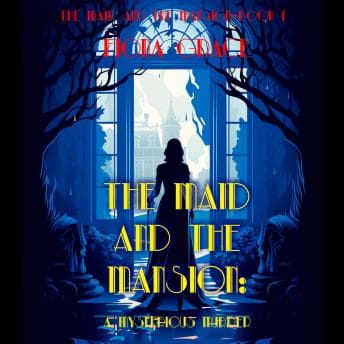
And that's genuinely frustrating, because the bones of this story are solid. Mary Adams—factory worker turned maid, navigating the treacherous waters of English aristocracy after WWII—is exactly the kind of protagonist I want in my cozy mysteries. She's sharp. She's an outsider with access, which is the perfect setup for amateur sleuthing. When her employer propositions her and ends up dead the next morning, she becomes the obvious suspect in a world designed to make women like her invisible.
That's good stuff. The class dynamics, the "maid as witness to secrets" angle, the historical setting—Fiona Grace clearly knows what she's doing with the genre. There's a reason she has multiple bestselling cozy series. The mansion setting promises eccentric suspects and whispered scandals, and the 4-hour-49-minute runtime suggests a tight, focused mystery rather than bloated padding. I got that same tight pacing from Sign of The Four, where Holmes cuts through the mystery without wasting your time.
But I kept getting pulled out of it. Every time Mary was about to uncover something, every time the tension should have been building—squawk. Other-wheezy. Voice shift.
The Uncomfortable Question
I listened to this at 2 AM, which is my preferred horror-adjacent consumption time. (Cozy mysteries aren't horror, but they're horror-adjacent. Fight me.) The darkness should have enhanced the atmosphere. The creaky manor, the post-war unease, the secrets lurking behind polite smiles. Instead, I found myself distracted, waiting for the next glitch.
Here's what bothers me: this is a debut novel in a series. It's meant to hook you, to make you fall for Mary Adams so you'll follow her through future investigations. And the synthesized narration actively works against that goal. Not because AI narration is inherently bad—the technology is improving rapidly—but because it's not there yet. Not for something that requires this much tonal control.
If the narrator doesn't commit to the creepy, I'm out. And a synthesized voice can't commit. It can approximate. It can mimic. But commitment requires understanding, and understanding requires... well, being someone.
Who Gets the Keys to the Manor (And Who Should Stay Outside)
If you're curious about the story and you read fast, grab the ebook. Fiona Grace writes competent, entertaining cozy mysteries with smart female protagonists. The post-war setting is a nice change from the usual contemporary or Regency fare. Mary Adams has potential. She's got that same sharp-observer quality I appreciated in Evil Beneath, where the protagonist sees what others miss.
But the audiobook? The audiobook is an experiment, and you're the test subject. Some listeners might find the quirks tolerable, especially at 1.25x speed where the glitches fly by faster. If you're someone who believes narration is half the audiobook experience—if a voice that doesn't quite land pulls you out of the story—skip this version. Wait for a human narrator, or read it yourself.
The Boom Mic Keeps Dipping
I wanted to love this. A working-class woman solving murders in mansions where she's supposed to be invisible? That's my jam. But every time I started to sink into the story, Amelia reminded me she wasn't quite real.
Shirley remained unimpressed throughout. For once, I agreed with her.