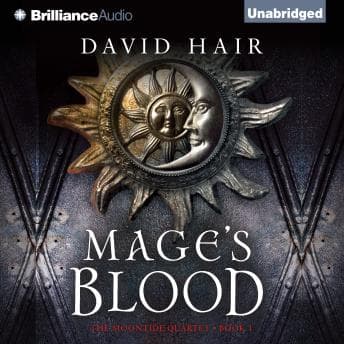

Twenty-six hours. Let me say that again. Twenty-six hours and eleven minutes. That's roughly the length of time it takes me to grade one set of junior year research papers, and I spent every last minute of this audiobook doing exactly that — red pen in one hand, earbuds in, Nick Podehl building an entire continent in my skull while I circled comma splices at 11 PM.
And here's my complaint: David Hair made me care about too many things at once. I'm already juggling 130 students and a wife who wants to know if I remembered to buy milk. I don't need four interlocking plotlines across two warring continents pulling me in different directions. But that's what Mage's Blood does, and by about hour ten, I'd stopped fighting it.
The Bridge That Explains Everything (Eventually)
So here's the premise, and it's genuinely clever: every twelve years, a massive bridge rises from the ocean connecting East and West, and the mage-blooded Rondian empire has used the last two of these Moontides to launch what are essentially magical crusades. Now the third one's coming and the Eastern peoples are ready to push back. It's the Crusades reimagined with a hard magic system, Indian-inspired mythology woven through the Eastern cultures (Hair drew on the Ramayana for his earlier YA work, and you can feel that influence here), and political scheming that would make Varys from Game of Thrones take notes.
But — and this is what the two-star reviews are right about — the first half of this book is slow. Not "Middlemarch slow" where every sentence is doing three things at once. More like "the author needs you to understand this world before the story can work" slow. There are stretches where Hair is essentially building his magic system brick by brick, and if you're listening at 1.0x like I do (the author chose those words, fight me), you feel every one of those bricks. My students would hate this. I actually respect it, but I understand the frustration.
The pacing complaint is real. It's the kind of info-dump that trusts you'll stick around for the payoff. And the payoff does come — the back half tightens considerably, the political threads start pulling against each other, and suddenly you realize all that setup was load-bearing.
Ramon Is the Reason You'll Keep Listening
Let's talk about what Nick Podehl does with this book, because he's carrying serious weight across 26 hours and dozens of characters. The man has fourteen AudioFile Earphones Awards, and you can hear why — but what impressed me most wasn't range, it was instinct. His Ramon is the standout. Ramon is the scrappy, irreverent friend-character who provides comic relief in a story that takes itself very seriously, and Podehl plays him with this loose, almost improvised energy that makes you grin every time he shows up. In a book full of scheming mages and doomed heroes, Ramon feels like the one guy who'd actually be fun to grab a beer with.
Podehl reads like someone who's internalized the politics of the world — the class tensions between full-blooded mages and half-bloods, the cultural divide between East and West. He shifts register in ways that communicate hierarchy without hitting you over the head. The narrator understands that pause is punctuation, and there are moments where his silence before a revelation does more work than the words that follow.
Now, I'll be honest — I don't have specific details on how he differentiates every single character voice across this massive cast. With this many players on the board, there are bound to be moments of overlap. But he never lost me. I always knew who was talking, which in a 26-hour fantasy with this many POV characters is no small thing.
Some Characters You'll Want to Argue With
Here's where I'll push back on some of the negative reviews: people complain that certain characters are frustrating or unlikable. And... yes. Some of them are. But this reminds me of what I tell my students about Wuthering Heights — you don't have to like Heathcliff to find him compelling. Hair writes characters who make bad decisions for understandable reasons, and a few of them are genuinely difficult to root for. That's not a flaw. That's the author doing something deliberate with moral complexity in a genre that often settles for clear-cut heroes. I ran into something similar reading Institute: A Novel — characters who made me uncomfortable in ways I eventually realized were completely intentional.
That said, some characters do feel underdeveloped compared to others. With this many threads — and this being the first of four books — there are POV characters who feel more like promises than fully realized people. You're investing in a long game here.
Content note: there's violence, language, and sexual content. This is adult fantasy and it earns that label. If you loved the political complexity of A Game of Thrones but wanted a magic system with more structure and a non-European cultural lens, this is its spiritual successor. Hair is doing something ambitious with his Crusades-meets-Ramayana framework, and the Eastern cultures aren't just set dressing — they're integral to the story's moral architecture.
Who Should Cross the Bridge
This is a book for patient listeners. If you need action in the first three hours or you're out, this isn't your entry point. But if you're the kind of person who enjoys world-building that rewards attention — if you listen at 1.0x because the prose deserves to be savored — there's real substance here. It demands focused listening. Don't try this one during a faculty meeting. (Trust me on that.)
If you loved the Stormlight Archive's scope or the Powder Mage trilogy's blend of magic and military politics, put this on your list. If you bounced off Malazan for being too dense, this is more accessible but scratches a similar itch.
Worth Pausing the Faculty Meeting For
Mage's Blood isn't perfect. It's a first book that sometimes feels like a first book — overstuffed in places, too eager to show its homework. But it's also genuinely imaginative, culturally rich in ways that most epic fantasy isn't, and performed by a narrator who knows how to make 26 hours feel like a commitment worth keeping. I've already got the second book queued up. Principal Martinez's next budget meeting should cover it.