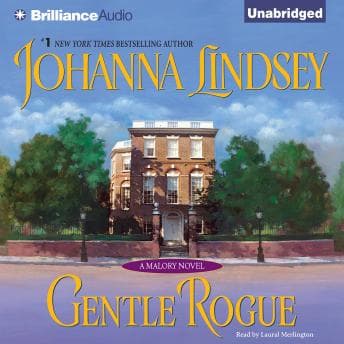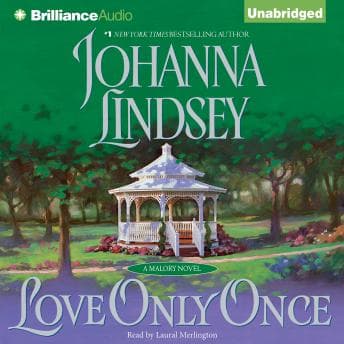

"The hot-tempered lady has vowed to wed him." That line from the description had me grinning before I even hit play, because honestly? That's the most telenovela premise I've heard in a Regency romance and Abuela would have loved this one. She would've been perched on the edge of her recliner, rosary in one hand, Diet Coke in the other, gasping at every plot twist like it was Corazón Salvaje.
I started this one on a lazy Saturday morning — cats fed, coffee poured, a logo redesign for a taco truck client on my second monitor that I was absolutely not going to touch for at least two hours. The vibes were right. Johanna Lindsey's Love Only Once is peak '80s historical romance energy: a spirited heroine, an emotionally constipated rake with a tortured past, a forced marriage, and a whole family of Malorys who are basically a pack of beautiful, aristocratic chaos agents. At under eight hours, it's a quick listen. A Sunday afternoon book, really. And I wanted to love it so badly.
The Malory Family Invented Drama and I Respect That
Let me start with what actually works here, because the Malory family dynamic is genuinely fun. Reggie — Regina Ashton — isn't just some wilting damsel. She gets abducted by Nicholas Eden (who mistakes her for someone else, classic), and instead of falling apart, she basically decides she will be the one to ruin him. The power reversal is delicious. And her uncles? Four overprotective Malory brothers who range from charming to terrifying? That's the kind of chaotic family energy I live for. You can feel Lindsey laying the groundwork for a whole series here, and it's effective — by the end I genuinely wanted to know more about Uncle Anthony and Uncle James. The chemistry between Reggie and Nicholas has moments of real heat, and there's a scene where Nicholas realizes he's actually fallen for her that hit me right in the chest. Not a full cry — more of a throat-tightening moment where I had to set down my stylus and just... sit with it.
But here's the thing. Nicholas's "painful secret" that drives most of the conflict? It's the kind of Big Misunderstanding that would be resolved in five minutes if anyone in this book had a single honest conversation. And I know, I know that's the genre convention, especially for 1985. But the way it drags through the second half — him pulling away, her confused, him pulling away again — I started losing patience around hour five. The emotional beats started feeling repetitive instead of escalating. I wanted to ugly-cry. I got frustrated instead.
Laural Merlington, Baby, We Need to Talk
Okay. So. The narration.
I went into this at my sacred 1.0x speed, ready to savor every word. And Laural Merlington is clearly trying. Her Reggie is fine — bright, a little breathy, you can hear the stubbornness. But the moment she voices Nicholas or any of the Malory men, something goes sideways. Nicholas Eden — this supposedly devastating, golden-haired seducer — sounds like someone's grandmother doing an impression of Colin Firth after watching one episode of Downton Abbey. The British aristocratic accent wobbles constantly, and there were at least two moments where it drifted into something that sounded vaguely Irish? Maybe Scottish? I genuinely couldn't tell. It pulled me out of the scene every single time.
And look — I'm not a snob about accents. I listen to romance audiobooks for eight hours a day. I've heard every accent attempt imaginable. But when the hero's voice makes you think "elderly woman at a tea party" instead of "dangerous rake who could ruin you," that's a problem. The emotional subtlety I need from a narrator just isn't here. When Nicholas has his vulnerable moments — and there are a few good ones in the text — the delivery stays flat where it should crack. Julia Whelan would have destroyed this role. I'm just saying.
Some listeners love Merlington's work here, and I respect that. Taste is taste. But for me, the narration kept this book at arm's length when I wanted it pressed against my heart.
Who Gets the Invitation (and Who Gets Left on Read)
If you're a Johanna Lindsey completist or you want the origin story of the Malory family saga, this is your entry point and it does its job — it sets up a world you'll want to revisit. If you love forced-marriage tropes and don't mind the hero being emotionally unavailable for roughly 60% of the book, you'll find things to enjoy here. The bones are good. The family banter is genuinely funny. The emotionally unavailable hero who takes forever to get out of his own way reminded me of Jesse Ward in Beneath This Man — different era, same infuriating pattern of pulling away right when you need him to lean in.
But if you need your narrator to sell the romance — if the voice is half the experience for you, the way it is for me — this audiobook version might leave you wanting. Read the paperback instead. Or wait and hope someone re-records it with a narrator who can make Nicholas sound like a man you'd actually want to be ruined by.
Abuela's Recliner Rating
This book felt like finding your abuela's favorite telenovela on a streaming service but dubbed with the wrong voice actors. The story underneath is dramatic, swoony, and full of the kind of family chaos that makes you want to pull up a chair. But something essential got lost in translation. My heart wanted to break open. It only cracked a little.
Three tissues out of a possible ten. Frida gave me a judgmental look when I sighed for the fourth time. She was right.