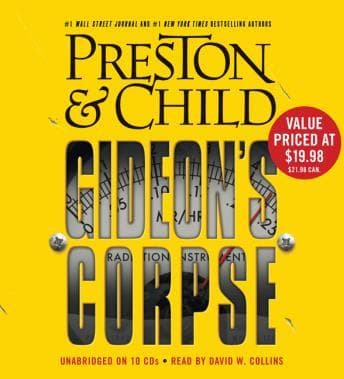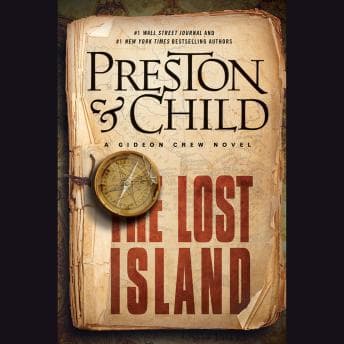

I was halfway through a chicken tikka masala—the kind that takes three hours because I refuse to take shortcuts with the marinade—when Gideon Crew broke into a museum to steal a page from the Book of Kells. And I stood there stirring my sauce thinking: okay, Preston and Child, you have my attention.
Here's the setup. Gideon Crew is a physicist with a terminal brain condition and a talent for thievery. His employer sends him on what should be impossible: steal a single illuminated page from one of the most protected manuscripts in the world. That's the first act. What follows is a treasure map hidden beneath medieval pigment, a trail of Greek-era clues, and eventually a journey to an uncharted island off the Mosquito Coast. It's Indiana Jones meets Michael Crichton, and for about seven of these eleven hours, it works pretty well.
The Psychology of a Man Running Out of Time
What makes Gideon interesting—not great, but interesting—is the ticking clock in his skull. He has a vascular brain malformation that gives him roughly ten months to live. The research actually shows that mortality salience changes decision-making in predictable ways: people either become more cautious or wildly reckless, and Gideon leans hard into the latter. Preston and Child get this right. His willingness to take absurd risks doesn't feel like plot convenience; it feels like a man who's already done the cost-benefit analysis and decided the costs don't matter anymore.
But then there's Amy. I found myself asking: why does Amy really tag along on this expedition? She's introduced as Gideon's partner, and David W. Collins narrates her with these higher, slightly enigmatic tones that suggest hidden depths. Collins actually does his best work with her—there's a guardedness in how he voices her dialogue that hints she knows more than she's sharing. And for a while, you buy it. Amy is the most psychologically layered person in the book, which is both a compliment to how she's written and a slight indictment of everyone else.
Where the Monster Eats the Mystery
Here's where I need to be honest. The first half of this book is a genuinely fun caper-meets-treasure-hunt. The Book of Kells heist is clever. The cryptographic puzzle-solving scratches a specific itch. But somewhere around the Caribbean, Preston and Child introduce a creature element—a monster, essentially—and the genre shifts under your feet. It's like watching a documentary about deep-sea archaeology that suddenly becomes Jurassic Park.
Psychologically, this doesn't track for me as a narrative choice. You've spent hours building a protagonist whose internal conflict is about mortality and meaning, and then you throw a physical threat at him that has nothing to do with that arc. The tension stops being "will Gideon find something worth living for" and becomes "will Gideon get eaten." Those are very different stakes, and the second ones are less interesting.
I know some listeners love this pivot. And look—Preston and Child know how to write action. They've been doing this for decades. But I've read enough of their work (the Pendergast series especially) to know they're capable of sustaining intellectual tension without defaulting to creature features. This felt like a choice made for pacing rather than character, and that always bugs me.
Collins Behind the Mic: Precision Over Passion
David W. Collins is technically excellent. His enunciation is impeccable—every proper noun, every geographic reference, every bit of archaeological jargon lands cleanly. You never rewind because you missed a word. That matters in a book this dense with historical and scientific detail.
But—and this is the thing—there's a flatness to his delivery that keeps you at arm's length. He narrates like a very skilled newscaster: clear, authoritative, slightly removed. For a thriller, you want moments where the narrator's voice cracks with urgency, where the pacing gets ragged because something terrible is happening. Collins stays measured throughout. It's professional. It's also a little bloodless.
The exception, as I mentioned, is Amy. Something about her character unlocks a different register in Collins. He gives her this quality that's hard to describe—almost musical, like she's always about to reveal something. My therapist would have thoughts about why the female character gets the most emotional range from a male narrator, but I'll leave that for another day.
Who This Is For (and Who Should Bail)
If you love Preston and Child's brand of smart-pulp adventure—think Relic, think Riptide—this is solid mid-series fun. The caper-plus-countdown energy also shows up in Robert Ludlum's The Bourne Sacrifice, though that one keeps its thriller instincts intact all the way to the final act—no monster detours required. It's the third Gideon Crew book, and listeners who've stuck with the series seem to consider it the strongest entry. If you're coming in cold, you can probably follow along, but Gideon's terminal diagnosis will hit harder if you've watched it develop.
If you need your thrillers to stay grounded in realism? You will be frustrated by the back third. Fair warning.
If audiobook narration needs to grab you by the throat? Collins might not be your guy. He'll teach you something. He won't shake you.
My Case File Note
This is a fascinating case study in a book that doesn't trust its own best instincts. The heist is smart. The treasure hunt is propulsive. The protagonist's mortality gives everything real weight. And then the authors blink and throw a monster at you, because apparently a dying man searching for meaning on a lost island isn't enough. It's still a fun eleven hours—I finished the tikka masala and kept listening through dishes and two cups of chai—but it could've been something sharper. Preston and Child understand human nature well enough to know that the scariest thing isn't what's lurking in the jungle. It's the clock that never stops ticking.