
How often do you actually listen when someone's talking to you—versus just waiting for your turn to speak?
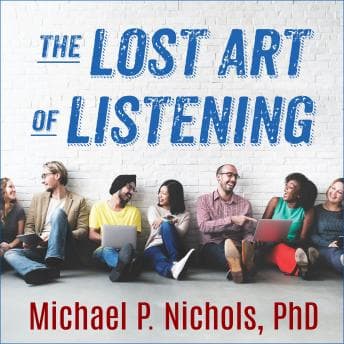
I caught myself doing exactly this on a packed 6AM Caltrain last Tuesday. Kevin was texting me about dinner plans, and I was mentally composing my response before I'd even finished reading his message. Then I realized: I was literally listening to a book about listening while failing to listen. The irony wasn't lost on me.
The Debugging Manual for Human Connection
Bottom Line: Worth your commute if you bump the speed. Nichols basically wrote a systems architecture doc for human communication—why our inputs get dropped, where the processing bottlenecks are, and how to actually implement fixes.
The core thesis is deceptively simple: most of us are terrible listeners because we're too busy formulating our response, defending our ego, or filtering everything through our own emotional state. Nichols breaks down the mechanics with clinical examples from his therapy practice—couples who've been having the same fight for twenty years because neither one actually hears what the other is saying. Parents who think they're connecting with their kids but are really just lecturing. Colleagues who wonder why their meetings are unproductive.
What I appreciated is that Nichols doesn't just tell you to "be more present" (thanks, every meditation app ever). He gets into the specific failure modes: reactive listening, where you're already formulating your counterargument; selective listening, where you only hear what confirms your existing beliefs; and my personal favorite—the empathy performance, where you're so focused on appearing empathetic that you miss the actual content.
The Speed Hack You Need
Here's the thing about Sean Runnette's narration: it's clear, professional, and delivered with genuine conviction. But at 1x speed? I wanted to throw my phone out the train window by hour three. His default pacing is glacial—like he's reading to a room of people taking notes by hand. Which, for a self-help book, maybe makes sense? But on a commute, it's brutal.
I bumped it to 1.5x (my usual) and suddenly the book clicked. Runnette's voice has this steady, therapist-like undertone that works great for the material—calm, authoritative, non-judgmental. But that same quality becomes monotonous at slower speeds. At 1.5x, he sounds like a really insightful friend explaining something important. At 1x, he sounds like he's billing by the hour.
The production is clean—no weird audio artifacts, no distracting music. Just Runnette and Nichols's words. For this type of content, that's exactly right.
Where the ROI Actually Is
The practical exercises are where this book earns its keep. Nichols includes specific techniques you can actually use—like the "speaker-listener" exercise where you literally take turns, with the listener required to paraphrase before responding. Sounds basic. Is surprisingly hard. I tried it with Kevin and discovered I habitually interrupt about 40% of the time. (He was very gracious about not saying "I told you so.")
The book also gets into the harder stuff—listening when you're triggered, listening to criticism, listening when you fundamentally disagree. Nichols doesn't pretend this is easy. He acknowledges that good listening sometimes means sitting with discomfort, and that's genuinely useful advice. Get Sh*t Done takes a similar no-BS approach to productivity—acknowledging the hard parts instead of pretending everything's a life hack.
My one gripe: this is the second edition, and some of the examples feel dated. References to answering machines, that kind of thing. The core principles are timeless, but occasionally I'd get pulled out by a scenario that felt very 2009.
Who This Is (and Isn't) For
This isn't a book you can half-listen to while debugging. It requires actual attention—which is kind of the point, I guess. I got the most out of it during focused commute time, not during my distracted morning coffee routine.
If you're in a relationship, work with people, or have family members (so... everyone), there's something useful here. If you're specifically dealing with communication breakdowns—the same argument on repeat, feeling unheard, wondering why your feedback at work never lands—the ROI on this audiobook is high.
Skip it if you're expecting a quick-fix listicle. This is 11+ hours of psychology, case studies, and exercises. Could it have been shorter? Probably. But Nichols is thorough, and the examples help the concepts stick.
The Commit Message
I finished this in about 5 commutes at 1.5x, and I've already caught myself using the techniques. Is it life-changing? That's a big claim. But it's made me more aware of my own listening failures, and that's step one. Kevin says I'm interrupting less. The bar was low, but progress is progress.
Bump the speed, give it your actual attention, and you'll get something useful out of it.