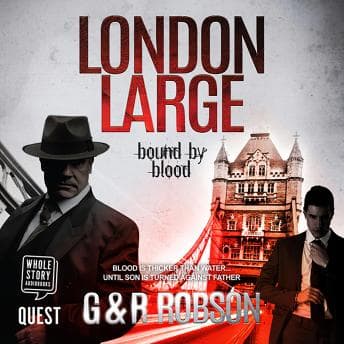

"His own neglected son has been sucked into the international crime ring responsible for one of the worst mass murders in British history."
That line from the book description alone hooked me. I was up late cleaning my Beretta - yes, Linda, I do that at 11 PM sometimes - and figured I'd give the second London Large book a spin. Ranger was already asleep on the couch, and I had nowhere to be until a client meeting at 0900. Eight and a half hours later, I had a clean firearm and a head full of grimy London underworld.
Let me cut to the chase: this is a solid B-grade British crime thriller that punches above its weight in some areas and stumbles in others. It's not going to rewrite the genre, but it kept me listening through the night, and that's saying something.
Old-School Copper in a World That's Moved On
Harry "H" Hawkins is the kind of detective I've met in real life - the grizzled operators who've been doing the job so long they've forgotten there are rules. He's coming off a mental and physical breakdown, which the Robson brothers handle with more honesty than I expected. The breakdown isn't just a convenient backstory; it bleeds into how H approaches the Bazza Wishbone murder investigation. He's slower, less certain, more volatile. I've seen this scenario play out in real life with guys coming back from deployment who aren't quite right yet but insist on getting back in the fight.
The father-son dynamic is where the book gets its teeth. When H discovers his own kid is tangled up with the crime ring behind those twenty bodies in a Kent mass grave, the investigation stops being procedural and becomes personal. That pivot from detective work to desperate father - that's what kept me from hitting pause. The book asks a question I find genuinely uncomfortable: what do you do when the mission and your family are on a collision course? I've watched good soldiers wreck themselves trying to answer that one.
But here's where it lost me sometimes. The writing can get a little... juvenile. Some of the dialogue reads like it was written for a Guy Ritchie film that didn't quite make the cut. Characters occasionally feel more like types than people - the corrupt villain, the loyal sidekick, the damaged hero. I ran into the same frustration with Triple Cross, where the villain is more cardboard cutout than credible threat - seems like a recurring problem in the genre when writers focus on plot mechanics at the expense of the people driving them. H himself has enough depth to carry the story, but the supporting cast doesn't always hold up their end. And the foul language - look, I spent 25 years in the Army, I'm not squeamish about profanity. But when every other sentence drops an f-bomb, it stops being gritty and starts being lazy. Use it for impact, not punctuation.
Wagland Earns His Pay
Greg Wagland does good work here. The author clearly did their homework on London's criminal geography, and Wagland sells it with his voice. He shifts between southeast London street accents and upper-class tones in a way that immediately tells you who's talking and where they sit in the food chain. When H is interrogating someone from the estates versus dealing with Metropolitan Police brass, the class divide comes through in Wagland's delivery without him hammering you over the head with it.
Is it the best narration I've ever heard? No. There are moments where the pacing feels a bit flat during what should be high-tension scenes - particularly around the mass grave discovery, which deserved more controlled intensity. But Wagland is consistent, professional, and he clearly understands these characters. For a solo narrator handling this many London voices, that's a decent achievement.
I ran it at 1.25x, my usual speed, and it worked fine. Wagland doesn't drawl, so you're not losing anything by nudging the tempo up.
Who's This For (And Who Should Walk Away)
If you like British crime fiction - think Luther or the old Bill Carter novels - and you don't mind your heroes rough around the edges, H is your guy. If you've read book one and liked it, this is a step up. The stakes are higher, the personal cost is real, and the Kent mass grave subplot adds genuine weight.
Skip it if you need polished literary prose. The Robsons write like guys who've lived in these neighborhoods, not guys who studied creative writing at Oxford. That's both its strength and its limitation. Also skip if graphic violence and heavy language bother you - this isn't a cozy mystery by any stretch.
Worth your time? Here's the debrief: it's a good late-night listen that won't change your life but will absolutely keep you locked in. The father-son thread elevates it beyond standard procedural fare. Ranger slept through the whole thing, but I think that says more about his age than the book's quality.
Not quite mission accomplished, but a successful patrol.