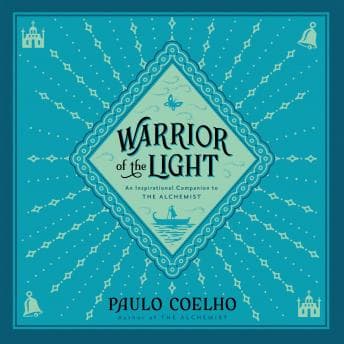

This is not really an audiobook you "read" so much as a small cache of spiritual prompts you let run in the background of your brain for a couple hours.
I put this on late at night while cleaning my kitchen after a long day of distributed-systems nonsense, and it weirdly fit that half-fried mental state. Not because it's plotty - it very much is not - but because Warrior of the Light: A Manual is built from short, aphoristic passages. Little bursts. One idea, then the next. Paulo Coelho keeps returning to the image of the "warrior" as someone who accepts failure, keeps faith with uncertainty, and treats simply being alive as its own kind of miracle. If that framing works for you, the audiobook goes down easy. If it doesn't, this can feel like listening to a very earnest fortune cookie generator.
Bottom Line: Worth your commute... if your commute is the reflective, stare-out-the-window kind, not the "I need my brain hijacked by plot" kind.
The ROI on this audiobook is mixed. It's only 2 hours and 16 minutes, so this is basically a spiritual pocket manual rather than a full listening project. I finished it in one evening and a little bit of the next morning. That brevity helps, because Coelho's style here is repetitive by design. He circles the same ideas - faith, doubt, perseverance, destiny, loss - from slightly different angles. Sometimes that lands like a meditation. Sometimes it feels like the same packet getting retried across the network a few too many times.
One thing that is very specific to this book: it leans hard on the phrase and persona of the "warrior of the light." That's not just branding from the title; it's the organizing metaphor for everything. And a second thing: this really does play like a companion piece to The Alchemist rather than a standalone argument. There's no narrative spine, no case-study structure, no practical workbook. Just compact reflections about embracing uncertainty, accepting failure without self-annihilation, and moving toward the person you want to become. If you come in expecting another allegorical story like The Alchemist, you're going to get a mismatch error immediately.
What actually works
When Coelho is in the zone, he's good at writing the kind of sentence that makes you stop folding shirts and go, "Okay, rude. Fair." The best sections are the ones that admit the warrior is not fearless or pure or permanently enlightened. He doubts. He hesitates. He loses. He keeps going anyway. I liked that this book doesn't frame failure as a bug to be eliminated. It treats failure as part of the operating environment.
That said - and this matters - the book is much stronger as a dip-in text than as a front-to-back audio experience. On paper, you can pause, underline, wander off, come back later. In audio, especially in one sitting, the repetition becomes more obvious. Coelho keeps restating the same emotional architecture in slightly different wording, and because there's no narrative escalation, your attention can drift. Not disastrously. Just enough that I wouldn't call this sticky listening.
Perfect for: bedtime, housework, a quiet walk where you want to think.
Skip for: deep work, high-focus commuting, or anyone craving concrete self-help tactics.
Greg Wagland keeps the temperature low
Greg Wagland makes a smart choice here by not over-performing it. There are no sound effects, no production gimmicks, no attempt to manufacture drama in a book that is basically a series of meditative assertions. It's clean audio, single narrator, very straightforward.
And honestly, that restraint is the right call.
Research on Wagland is pretty sparse, and I didn't catch any standout accent quirks or pronunciation issues worth flagging. What he does bring is a reflective, even delivery that suits the material. He sounds like someone reading a small book of maxims to a room that has finally gone quiet. That helps. A pushier narration would've made the whole thing feel fake-spiritual fast.
The downside is that the performance rarely adds extra dimension. Since the text already operates in a narrow emotional band - calm, sincere, gently exhorting - the narration stays in that same lane. So if you're not vibing with Coelho's language, Wagland probably won't convert you. He supports the material well; he doesn't elevate it into something bigger.
I listened at 1.25x, which felt right. At 1.5x, the meditative cadence starts to sound a little too clipped, like inspirational middleware being processed too fast.
Who Should Listen (And Who Should Skip)
Get this if you liked the spiritual tone of The Alchemist but wished you could extract just the quotable philosophy layer and carry it around in your pocket. Also get it if you enjoy devotional-style listening - short reflections, symbolic language, not a lot of hard structure, and zero pressure to remember plot details.
Maybe skip, or at least borrow first, if you want self-help with real implementation steps. There's no framework here. No habit system. No behavioral model. No science. This is not Atomic Habits for mystics. It's closer to a spoken book of affirmational parables without the parables. I had a similar experience with How to Hear from God - another devotional-adjacent listen that operates entirely on faith that the reader is already on board with the spiritual register, and lands softly if you're not.
And if you already bounced off Coelho before, this won't change your mind. The criticism that it doesn't live up to his stronger work feels fair. Not because it's bad. More because it's slight. Pleasant, sincere, occasionally sharp - but slight.
My deploy recommendation
I'm landing on wait for sale, bordering on borrow/stream. The short runtime matters. This isn't a bad audiobook at all; it's just not one I'd spend a full credit on unless you are already very much on Coelho's wavelength.
There are a few lines in here that will probably stick. A few that might hit you at exactly the right moment. But as a complete audio package, it feels more like a small reflective companion than an essential listen.
Useful. Calming. A little repetitive. Pretty much exactly what the title promises.