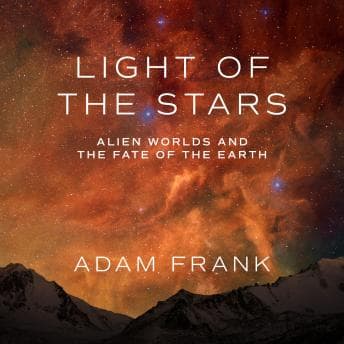

Look, if you're picking this up because the title promises alien worlds and you're expecting first contact scenarios or deep Drake equation rabbit holes... you're going to spend the first couple hours mildly annoyed. I was. I grabbed this for a Saturday afternoon debugging marathon - one of those "the metrics look wrong but nothing is actually broken" situations that eats your whole weekend - and I kept waiting for the aliens to show up.
They don't. Not really. And that's actually the point.
The Bait-and-Switch That Actually Works
Adam Frank pulls what I'd call a classic refactoring move: he takes the climate change conversation - a topic most of us have heard so many versions of that our brains auto-filter it - and reframes the entire thing through astrobiology. The argument goes like this: the universe has probably produced billions of civilizations. Many of them probably discovered energy. Many of them probably burned through that energy in ways that altered their planets. So what happened to them?
It's basically the Fermi Paradox rewritten as a systems engineering problem. And as someone who spends her days thinking about distributed systems failure modes, this hit different. Frank treats civilizations like processes running on planetary hardware - you can only push your host system so far before you get cascading failures. Venus is the production server that melted down permanently. Mars is the one that lost its atmosphere - like a service that ran out of memory and nobody noticed until it was too late. Earth is the one still running, throwing warnings we keep snoozing.
The Venus and Mars sections are genuinely good. Frank walks through the actual planetary science - how Venus's runaway greenhouse effect turned it into a 900°F hellscape, how Mars lost its magnetic field and then its atmosphere - and uses these as real data points in what he calls "the experiment" the universe has been running for billions of years. The science actually holds up. I couldn't help thinking about Return of the God Hypothesis—that book tackles the same cosmic scale but arrives at a very different conclusion. He's not handwaving. He's an astrophysicist at the University of Rochester who's published peer-reviewed papers on this exact framework, and you can feel the rigor underneath the accessible language.
Where the Signal Gets Noisy
Here's where I push back: the middle section on Gaia theory and the history of climate science drags. Frank spends a lot of time on the intellectual lineage - Aristotle to Copernicus to Carl Sagan - and while I get why (he's building credibility for his framework), it felt like reading through a well-documented PR description when I just want to see the actual code change. I already bought your argument, Adam. Let's get to the implications.
The last third picks back up when he introduces his mathematical models for how civilizations might respond to planetary change. He lays out scenarios - soft landing, gradual decline, full collapse, oscillation - and maps them to actual differential equations. He doesn't get too deep into the math in the audio format (probably wise), but knowing it's grounded in peer-reviewed modeling rather than vibes-based speculation gives the whole thing real weight.
At 1.5x, Kevin Pariseau's narration handles this well. He's got that NPR-adjacent delivery that works perfectly for popular science - measured enough for the dense atmospheric chemistry bits, warm enough that you don't zone out during the historical detours. Clean audio, steady pacing, no weird production quirks. Not a performance that'll make you forget what you're listening to - but for a book like this, that's exactly right. You want the ideas front and center, not the narrator's personality.
Who Should Grab This (And Who Should Skip)
Perfect for: anyone in STEM who's tired of the standard climate doom-scroll narrative but still wants to engage with the science. If you've ever thought about planetary systems as, well, systems - feedback loops, tipping points, resource constraints - this book speaks your language without dumbing it down. Also great if you loved Project Hail Mary's science-forward approach and want something in the nonfiction lane.
Skip if: you want actual alien speculation. This is not Three-Body Problem. The "alien worlds" in the title refer to statistical probability and planetary case studies, not stories about extraterrestrial life. Also skip if you already have a strong background in planetary science or climate modeling - the Venus and Mars material might feel like review.
git commit -m "planetary perspective shift"
TL;DR: Worth your commute. Adam Frank took the climate change conversation and gave it the framework it desperately needed - cosmic perspective backed by real math. It's basically Site Reliability Engineering but for civilizations. The ROI on this audiobook is high if you're the kind of person who thinks in systems and feedback loops. I finished this in about 2.5 commutes at 1.5x and immediately texted Kevin (boyfriend Kevin, not narrator Kevin) a rant about Venusian atmospheric pressure that he absolutely did not ask for. Seven hours well spent.







![Steve Jobs [unabridged audiobook] audiobook cover](/_next/image?url=https%3A%2F%2Fcovers.audiobooks.com%2Fimages%2Fcovers%2Ffull%2F9788499923406.jpg&w=1920&q=75)