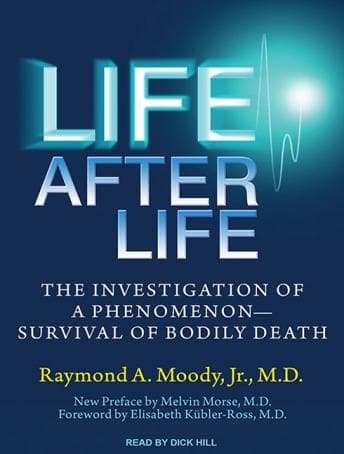

What happens when a psychiatrist with an MD decides to approach the question of death the way an engineer approaches a bug report — collect the data, find the patterns, document everything?
That's basically what Raymond Moody did in 1975, and honestly, as someone who spends her days hunting anomalies in distributed systems, I found his methodology weirdly... familiar. He gathered over a hundred accounts from people who were clinically dead and came back, then catalogued the recurring elements: the tunnel, the being of light, the life review, the boundary they couldn't cross. It's pattern recognition applied to the most existential dataset imaginable.
The Original Near-Death Bug Report
Look, I picked this up after a brutal on-call week where I'd been staring at dashboards until 1AM, couldn't wind down, and needed something completely orthogonal to work. And this delivered in a strange way. At 5 hours 25 minutes, it's compact — I knocked it out in about two and a half commutes at 1.5x. Moody structures the book almost like a research paper: here's the phenomenon, here are the common elements, here are the variations, here are the objections, here's my analysis. As a CS person, I appreciated the systematic approach. He doesn't just dump anecdotes on you — he identifies roughly fifteen distinct elements that recur across cases (the buzzing/ringing noise at death, the out-of-body experience, meeting deceased relatives, the being of light) and then cross-references which subjects reported which elements.
What surprised me is how restrained Moody actually is. I expected woo-woo hand-waving, but he spends a solid chunk of the book addressing skeptical explanations — pharmacological effects, oxygen deprivation, temporal lobe stimulation — and while he clearly believes something real is happening, he doesn't claim he's "proved" an afterlife. He's more like: here's the data, the patterns are too consistent to dismiss, and our current frameworks can't fully explain it. That intellectual honesty earned him points with me. It's the same quality I noticed in Self-Reliance — a writer who's clearly arrived at strong convictions but still leaves room for you to push back.
Dick Hill Does The Heavy Lifting
Dick Hill is a Golden Voice narrator for a reason, and he brings exactly what this material needs: steady, clear, authoritative delivery that doesn't tip into melodrama. When he's reading the actual testimony of someone describing floating above their own body during surgery, he keeps it grounded — almost clinical. Which is exactly right, because the content is emotional enough on its own. You don't need a narrator cranking the sentiment up to eleven when someone's describing watching doctors try to resuscitate their dead body.
That said, this isn't a narrator performance that's going to blow your mind. It's single-narrator, no sound effects, no production flourishes. Hill reads it straight. For this kind of material, that's the correct choice. But it does mean some of the more technical or philosophical sections — particularly when Moody gets into parallels with Plato's Republic and the Tibetan Book of the Dead — can feel a bit flat at 6AM on a packed Caltrain. I bumped to 1.5x for those stretches and it helped.
Where The System Crashes
Here's my honest frustration: the book is from 1975, and it shows. Moody's sample is entirely self-selected — people who voluntarily shared their experiences. There's no control group, no statistical rigor, no blinding. He acknowledges this, but if you're coming at this with any kind of empirical mindset, you'll spend half the book mentally appending asterisks. The accounts themselves are genuinely fascinating (one woman describes accurately reporting conversations happening in another room while she was clinically dead, which — okay, that's hard to explain away), but the framework around them feels more like journalism than science.
Also, the pacing drags in the middle when he's cataloguing variations of the same fifteen elements across dozens of cases. After the fifth person describes the tunnel of light, you get it. Could've been tighter. At 5.5 hours it's already short, but honestly this could've been a 3-hour book without losing much.
Who Gets Value From This
Perfect for: anyone curious about where the whole "tunnel of light" cultural meme actually originated. If you've ever heard someone describe a near-death experience and wondered where the script came from — this is literally the source text. Also good for skeptics who want to engage with the best version of the argument rather than strawman it.
Skip for: anyone expecting rigorous scientific methodology. This is qualitative research from the '70s, pre-IRB, pre-replication-crisis awareness. Also skip if you're grieving and looking for comfort — the clinical tone might feel cold rather than reassuring.
The ROI on this audiobook is decent for the time investment. Five and a half hours for a book that genuinely changed how Western culture thinks about death? That's a pretty good ratio, even if the execution hasn't aged perfectly.
Commit Message: Worth The Checkout
TL;DR: Worth your commute if you treat it as a historical document — the founding text of near-death experience research — rather than definitive proof of anything. Moody's pattern-matching approach will appeal to anyone with a systematic brain, even as his methodology makes your inner scientist twitch. Dick Hill's narration is clean and professional, if unremarkable. I wouldn't spend a full credit on this, but it's a solid library grab or streaming pick for a week of shorter commutes.