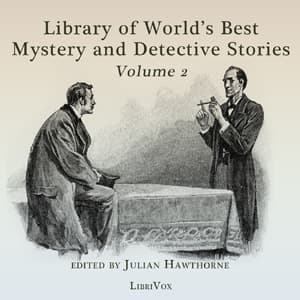

"The facts I am about to relate are authenticated by the testimony of two knights of Rome." That's Pliny the Younger, writing nearly two thousand years ago about a haunted house in Athens, and it's the first thing that grabbed me in this collection. I was up late - couldn't sleep, which happens more than I'd like to admit these days - scrolling through LibriVox looking for something to burn through, and this anthology caught my eye. Volume 2 of Julian Hawthorne's Library of the World's Best Mystery and Detective Stories. English and Scotch authors. Ten and a half hours. Free. Figured what the hell.
Let me cut to the chase: this is a mixed bag, and you need to know that going in.
When a Ghost Story Was Still Dangerous
What struck me hardest about this collection is how old some of this material is. We're not just talking Dickens and Wilkie Collins era - Hawthorne reached back to Pliny the Younger and pulled in a Tibetan manuscript, which for an early 20th-century anthology was pretty ambitious. The English and Scottish stories here range from the genuinely unsettling to the quaint, and the tonal whiplash between entries is part of the charm. One story reads like a proper detective procedural - the kind of methodical puzzle-solving that clearly influenced everything from Conan Doyle forward - and the next is pure gothic atmosphere, all creaking floorboards and unexplained phenomena. I Know a Secret scratches a similar itch if you want that same methodical, evidence-first approach without having to wade through a century of genre history to find it.
The detective stories hold up better than you'd expect. There's a directness to the older British mystery writing that I appreciate - no hand-wringing, no padding, just here's the problem, here's the evidence, here's the solution. Some of these authors were working out the rules of the genre in real time, and you can feel them figuring out how much to reveal and when. The horror entries are more uneven. A few land hard - genuine dread built through restraint rather than shock - but others feel like campfire stories that ran long.
Here's the thing: at ten and a half hours across multiple stories, this works as a sampler platter. You're not committing to a 400-page novel with a single author. If one story doesn't grab you, another starts in twenty minutes. That's actually a strength for audiobook format.
The LibriVox Variable
Now let's talk about the elephant in the room. LibriVox volunteers. God bless them for doing this work - seriously, making public domain literature available in audio for free is a genuine service. But the quality is... inconsistent. You get readers who clearly love what they're doing and bring genuine presence to the text, and you get readers who sound like they're recording in their kitchen during a thunderstorm. The transitions between different volunteer narrators can be jarring - one story ends with a confident, measured British delivery, the next opens with someone who sounds nervous and rushed.
No character differentiation to speak of in most readings. When a story relies heavily on dialogue between multiple characters, you're doing mental work to track who's speaking. For the more atmospheric, description-heavy pieces, this matters less. For the detective stories where conversations drive the plot, it's a real limitation.
I bumped up to 1.25x (my standard) and a couple of the slower readers actually benefited from it. A few of the faster ones got a little breathless at that speed. So I ended up adjusting more than usual, which is mildly annoying when you're trying to fall asleep or zone out on a drive.
Who Should Saddle Up (And Who Should Pass)
If you're a mystery/detective history nerd - the kind of person who wants to trace the genre back to its roots - this is genuinely interesting. Seeing how British and Scottish writers built the conventions we now take for granted is worth your time. If you want polished, professional narration with distinct character voices and clean production, this isn't your stop. It's free, it's public domain, and it sounds like it.
I'd also say this works best as background or bedtime listening. The short story format means you can drift off mid-story and not lose the thread of a 30-hour plot. I burned through about half of it during a week of insomnia sessions with Ranger snoring at my feet, and the other half on drives between client meetings around Austin.
Worth your time? Here's the debrief: for free audio of historically significant mystery fiction, you could do a lot worse. The source material ranges from genuinely excellent to merely interesting, and the narration ranges from solid to rough. Temper your expectations, treat it like browsing an old bookshop rather than buying a bestseller, and you'll find some real gems buried in here. That Pliny the Younger haunted house piece alone is worth an hour of your evening.
Ranger slept through most of it. But he always perks up during the ghost stories.