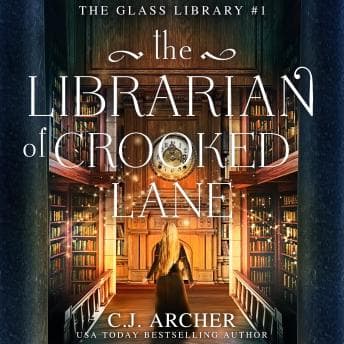

Look, I need to complain about something first: why does every cozy fantasy mystery insist on giving me a love interest who's described as "dangerous" when the most dangerous thing he does is brood attractively and solve crimes? Gabe is a war hero, sure, and he's got that whole tortured-past thing going on, but let's be honest - this is a man who spends most of his time being polite to librarians and feeling guilty about getting Sylvia fired. Real menace there, buddy.
That said, I listened to this whole thing during a marathon board game night where my friends were playing Gloomhaven without me because I'd already been eliminated. (Don't ask. My Brute got wrecked by a bear. A BEAR.) And you know what? Sitting in the corner with my earbuds in while my buddies looted treasure was actually the perfect vibe for this book. It's warm, it's low-stakes enough to half-zone into, and it scratches that "magic exists but we're being very British about it" itch. The genre has some genuinely gripping neighbors though — Dark Horse kept me just as engaged during a late-night session, but with a tension level that actually made me put my phone down.
The Magic System Is... Wait, Where Is It?
Okay so here's the thing that's going to divide people. C.J. Archer sets up this world where magicians exist - they can imbue objects with magical properties, there's a whole social hierarchy around magical families, there's a library housing the world's greatest collection of books about magic. That's a LOT of worldbuilding infrastructure. But the actual magic? It stays frustratingly vague for most of the book. We get the concept of magician-made objects (like the stolen painting that kicks off the mystery), and Sylvia's whole quest to figure out if she's descended from magicians, but the rules of how magic actually works stay pretty fuzzy.
For someone like me who needs a Sanderson-level magic system to feel satisfied - you know, clear rules, defined limitations, logical consequences - this was a bit like ordering a fantasy entrée and getting a mystery with fantasy seasoning. Not bad! Just different from what the menu implied.
What Archer does really well is the social dynamics around magic. The class structure, the way magical lineage creates power imbalances, the tension between those who have magic and those who don't - that stuff is genuinely interesting. It's less "here's how fireballs work" and more "here's how magical aristocracy perpetuates itself." My D&D group would love this as setting material for a political intrigue campaign, actually.
Marian Hussey and the Case of the American Cousin
Hussey's narration is solid. She's got distinct voices for the main cast, and her Sylvia feels natural - warm, curious, a little uncertain in the way someone discovering their identity should sound. The tone matches the cozy mystery energy perfectly, and I never lost track of who was speaking during dialogue scenes.
But I have to address the elephant in the room: the American cousin's voice. One listener called it "very annoying" and... yeah, I get it. It's one of those accent choices where you can feel the narrator reaching for something specific and landing about three inches to the left. It's not deal-breaking, but every time that character showed up I could feel my brain going "oh, here we go." It's like when a DM does a bad Southern accent for an NPC and the whole table just quietly agrees to move past it.
Eight Hours of Cozy With a Side of Abrupt
At 8 hours and change, this is a quick listen by my standards. (I routinely commit to 40+ hour Sanderson behemoths, so anything under 10 feels like a short story.) The pacing is gentle - character-driven, relationship-focused, with the mystery of both the stolen painting and Sylvia's heritage unfolding at a leisurely pace.
And that's where the criticism is fair: it does lag in spots. There are stretches in the middle where the investigation kind of meanders, and you're waiting for either the mystery or the romance to pick up momentum. When the ending does arrive, it feels rushed - like Archer suddenly realized she needed to wrap things up and save material for the next book. If you're coming from the Glass and Steele series, you apparently get more context for the world, but as a standalone entry point, some connections felt like I was missing homework I didn't know was assigned.
Roll for Recommendation
If you want a cozy historical fantasy mystery with a slow-burn romance, solid narration, and a world that hints at deeper magic without fully showing its hand - this works. It's comfort food fantasy. It's the audiobook equivalent of a warm scone and tea on a rainy afternoon.
But if you need hard magic systems, fast pacing, or a mystery that keeps you white-knuckled, this isn't your quest. I read this instead of writing my thesis, and honestly, it was pleasant enough but didn't wreck my sleep schedule the way a truly addictive book does. It's a gentle start to what could become a really interesting series if the magic system gets more definition in later books.
For my fellow D&D nerds: think of this as a session zero. Good characters, interesting world, but we're still waiting for the real adventure to kick off.