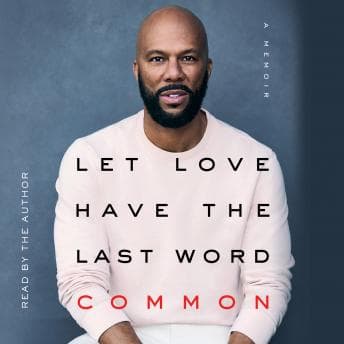

Look, I'll be honest—I didn't expect to spend five hours listening to a rapper talk about love. My usual audiobook diet is all McKinsey case studies and founder memoirs. But Jenny's been on this kick about me "expanding my emotional vocabulary" (her words, not mine), and Common's memoir was sitting in my library from some sale I forgot about.
Bottom line: This isn't a business book. But it might be the most useful thing I've listened to this quarter.
When a Hip-Hop Legend Gets Vulnerable
I started this on a red-eye to Chicago—ironic, since Common grew up there. Something about being 35,000 feet up, exhausted, with Common's voice in my ears talking about his daughter, his failures as a father, his childhood trauma... it hit different than I expected.
Here's the thing. Common narrates this himself, and that Chicago accent, that cadence—it's not polished audiobook narration. It's a guy sitting across from you, being honest. Some reviewers complained it's too slow. They're wrong. The pacing is deliberate. He's not rushing through the hard stuff, and there's a lot of hard stuff here.
The molestation revelation? I wasn't prepared for that. He drops it without fanfare, and you can hear him working through it in real-time. I Know Why the Caged Bird Sings has that same unflinching honesty about childhood trauma—Maya Angelou narrates her own story with similar rawness. My parents never talked about feelings. Korean immigrant hustle doesn't leave room for therapy. Listening to Common process his trauma out loud felt almost intrusive—but also necessary. Like watching someone model what emotional honesty actually looks like.
The Business Case for Love (Yes, I Went There)
Okay, so here's where my consultant brain kicked in. Common structures love like a framework—God, self, partners, children, family, community. It's almost like a stakeholder map, if your stakeholders were everyone you've ever cared about.
And you know what? It works. Not in a cheesy self-help way. He's not giving you "5 Steps to Better Relationships." He's showing you how he failed, what he learned, how he's trying to do better. The section on his daughter Omoye—about how he wasn't present enough, how he's working to repair that—reminded me of conversations I should probably have with my own dad.
(Don't tell him I said that.)
The community chapter hit hardest for me professionally. Common talks about love as a form of leadership. About how you can't build anything sustainable—a movement, a company, a family—without genuine care for the people involved. I've watched startups implode because founders treated employees like resources instead of humans. This isn't new insight, but hearing it from someone outside the business world, framed through love instead of "culture" and "engagement"? It landed.
Where It Drags
I won't pretend this is perfect. Some sections feel like Common is preaching more than sharing. The God stuff might lose secular listeners—he's deeply spiritual, and that's woven throughout. If that's not your thing, you'll zone out in places.
And yeah, the narration can get a bit flat. Common's not a trained voice actor. There are moments where his delivery goes monotone, especially in the more philosophical passages. I bumped it to 1.25x during those stretches. Not my usual 2.0x, though—this material needs breathing room.
At just over five hours, it's lean for a memoir. That's actually a compliment. He says what he needs to say and gets out. My parents would approve of that efficiency.
The ROI on Emotional Honesty
Probably won't listen again cover-to-cover. But I've already bookmarked the fatherhood chapter. And the one about forgiveness. Those are the kind of sections you return to when you need a reset.
Jenny asked me what I thought when I got home. I told her it was "surprisingly applicable." She laughed and said that was the most David Park compliment possible.
She's not wrong.
Who's this for: If you're a fellow efficiency-obsessed professional who thinks emotions are inefficient—this is your gateway drug. Skip it if spiritual content makes you tune out, or if you need high-energy narration. But if you're ready to think about how you show up for people? Common's not trying to make you cry (though you might). He's trying to make you examine your relationships. And that's a skill that compounds.