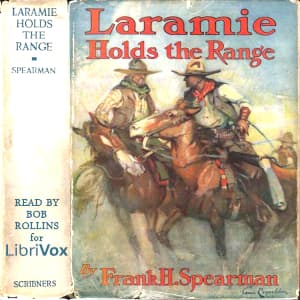

"Kate had never seen her father. She had never seen the West."
That line - or something very close to it - lands early in this novel, and it stopped me cold. Not because it's pyrotechnic prose. Because it's so plain, so matter-of-fact, and yet it contains the entire emotional engine of the story. A woman traveling toward a stranger who happens to share her blood, into a landscape that doesn't care whether she survives the introduction. Frank Spearman understood that the West wasn't just a setting. It was a character with teeth.
I was walking the lakefront with Denise on a Sunday morning when this one really started to click - somewhere around hour three, when Spearman stops moving chess pieces and just lets the Wyoming landscape breathe. The wind off Lake Michigan felt almost cooperative.
The Land Talks More Than the Cowboys
Here's what Spearman does that most Western writers of his era didn't bother with: he treats geography as psychology. When Laramie rides through the mountain passes, the descriptions aren't just pretty scenery cards shuffled between gunfights. The altitude, the exposure, the sheer indifference of rock and weather - these mirror the isolation of a man who's been squeezed out by the big cattlemen and knows it. Spearman was writing in the early 1900s, and he'd actually lived in Nebraska, worked as a bank president out there. The man knew what open country felt like when it was being carved up by railroads and cattle barons. You can feel that firsthand knowledge in sentences that don't strain for beauty but find it anyway.
The Kate Doubleday plot is, on paper, familiar territory - the Eastern woman arriving in the West, the gradual toughening, the romance with the principled loner. But Spearman doesn't rush her transformation. Kate's adjustment isn't a montage. It's awkward and incremental, and her relationship with her father carries a genuine coldness that surprised me. This isn't a tearful reunion story. It's two people figuring out whether blood actually means anything when you've been strangers for twenty-odd years.
This reminds me of what Hemingway said about prose - that the dignity of movement of an iceberg is due to only one-eighth of it being above water. Spearman keeps most of the emotional weight under the surface. The range war plot provides the action, but the real tension is domestic, familial, unspoken.
Bob R and the Art of Staying Out of the Way
Now, here's where I have to be honest: I couldn't find much critical commentary on Bob R's narration specifically, and the recording appears to be a LibriVox-style production. What I can tell you is that the narration is steady and clear - Bob R reads at a pace that respects Spearman's sentences, which tend toward the declarative and don't need a lot of vocal fireworks. The narrator understands that pause is punctuation, and with Spearman's landscape writing, that matters. You need the space.
What you won't get is a full theatrical performance with distinct character voices for every rancher and railroad man. This is a single narrator reading a novel the way someone might read aloud by a fire - present, unhurried, a little flat in spots where a more dramatic reader might have punched up the confrontation scenes between Laramie and the cattlemen's faction. For an 11-hour-51-minute listen, that evenness can feel like both a strength and a limitation. During the quieter descriptive passages, it works beautifully. During the action sequences - and there are a few genuine shootout moments - I wanted more heat.
I wouldn't call the production polished in the way a Big Five publisher release would be. But it's clean, the audio quality is consistent, and there's something almost appropriate about the modesty of the recording matching the modesty of Spearman's prose. My students would hate this. I love it. (They'd also hate that it's nearly twelve hours about a rancher in Wyoming. Their loss.)
Who This Is For - And Who Should Keep Walking
If you loved Wister's The Virginian, this is its spiritual successor - quieter, less mythologizing, more interested in land and economics than heroic archetypes. If you're a Cormac McCarthy reader looking backward for the roots of literary Westerns, Spearman is worth your time. He's not McCarthy - nobody is - but he's doing something similar with landscape as moral force, just without the apocalyptic dread.
If you need fast plotting and constant tension, this will test you. The pacing is deliberate. Spearman builds his world brick by brick, and some of those bricks are just gorgeous descriptions of mountain ridgelines that don't advance the plot one inch. I found them worth savoring. The prose deserves to be savored. But I teach Faulkner to teenagers, so my tolerance for slow narrative builds is professionally calibrated.
Skip this if you want a modern audiobook experience with full-cast energy and cinematic pacing. Come to this if you want to understand why the Western genre, before Hollywood got its hands on it, was actually literary fiction about class, land, and the cost of American expansion. I'll admit White Noise scratches a similar itch for me in a completely different century - DeLillo is also fundamentally writing about the cost of American systems, just swap Wyoming rangeland for a suburb full of brand names.
Worth Pausing the Faculty Meeting For? Almost.
Not quite - I'd save the budget presentation distraction for something with a narrator who pushes harder. But for a free LibriVox recording of an unjustly forgotten early Western novelist? This earns its place in the rotation. Spearman wrote like a man who'd watched the frontier close and wanted to pin it to the page before it faded entirely. That impulse - preserving something vanishing - comes through even in a modest audio production. This is why we still read the classics, even the ones nobody remembers are classics.









