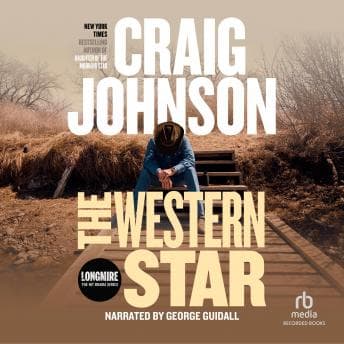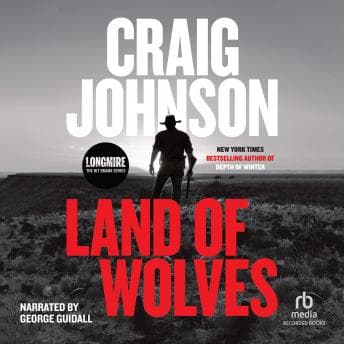

Look, I need to rant about something for a second. Why doesn't the Longmire series get more love in fantasy circles? Yes, I know it's technically a mystery western. But hear me out—you've got a protagonist who's basically a paladin with a badge, mystical wolf symbolism, Basque folklore, and the Big Horn Mountains functioning as their own character. This is fantasy-adjacent at minimum, and I will die on this hill.
Okay, rant over. Let me tell you about Land of Wolves.
The Wolf as a Narrative Device (Yes, I'm Making This a D&D Thing)
So Walt Longmire is recovering from some seriously traumatic stuff that went down in Mexico—the kind of PTSD arc that would make for excellent character backstory in any campaign. And Craig Johnson does something really clever here. He introduces this oversized wolf in the Big Horn Mountains, and Walt starts feeling... connected to it. Empathetic. Like recognizes like, you know?
This isn't just window dressing. The wolf functions almost like a spirit animal companion—if your DM was subtle about it instead of giving you a stat block. Walt's investigating what might be a suicide, might be a murder, involving a shepherd with ties to a Basque family that has a history of (and I'm quoting here) "removing the legs of Absaroka County sheriffs." That's metal as hell. The wolf watching from the mountains while Walt pieces together this dark puzzle? Chef's kiss on the atmosphere. That same lived-in quality made Holes work so well—both books trust you to piece together the mythology without spelling everything out.
Johnson's world-building is the kind I appreciate—it's not info-dumpy, it's lived-in. You feel the isolation of Wyoming, the weight of history in these ranching families, the way violence echoes through generations.
George Guidall: The Bard With 20 Charisma
I listened to this during a coding marathon when I was definitely not working on my thesis (Dr. Patel, if you're reading this, I was absolutely working on my thesis). And George Guidall's voice? Perfect background for that semi-focused state where you need something engaging but not demanding.
His Walt Longmire is this semi-rough, laid-back delivery that just fits. It's like he's telling you this story over beers at a bar where everyone knows your name and your grandfather's name. The man's won Audies for a reason. When Walt's internal monologue gets heavy—and it does, given the PTSD thread running through this—Guidall conveys that weight without going full melodrama.
Now, I'll be honest. There were a couple spots where I had to rewind because the clarity got a bit muddy. Not often, but enough that I noticed. Could've been my cheap earbuds, could've been the recording. Hard to say. It didn't tank the experience, but if you're the type who needs crystal-clear enunciation at all times, maybe bump up the volume or grab better headphones.
The Basque Element (Underrated World-Building)
Can we talk about how underused Basque culture is in American fiction? Johnson weaves in this whole thread about Basque shepherding families in Wyoming, and it's fascinating. The history, the isolation, the generational feuds—it adds texture to what could've been a straightforward whodunit. My D&D group would absolutely steal this for a campaign setting. Remote mountain community with ancient grudges and mysterious deaths? That's a session zero right there.
Roll for Initiative (Or Don't)
Here's the thing about book fifteen in a series—you're either already invested or you're not. Can you start here? Technically, yes. Johnson gives you enough context. But you'd be missing the accumulated weight of Walt's journey, and that matters for the emotional beats.
This one's for you if: you like your mysteries slow-burn and character-driven, you appreciate world-building that doesn't hold your hand, or you've been riding with Walt since the beginning. Skip it if: you need action every chapter, hate deliberate pacing, or can't stand traditional western masculine sensibilities. The middle third drags a bit—I zoned out during one stretch—but the payoff lands.
Packing Up the Character Sheet
At 8 hours and change, this is a comfortable listen. Not a massive time commitment, not a quick read. Guidall makes it easy to sink into, the mystery has enough twists to stay interesting, and the wolf symbolism gives it this slightly mythic quality that elevates it above standard procedural fare.
Would I recommend it? If you're already a Longmire fan, absolutely. If you're new to the series, maybe start earlier—but if you're stubborn, you'll be fine.
I'm giving this a solid listen. Now if you'll excuse me, I have a thesis I'm definitely going to work on. (I'm going to start the next Longmire book.)