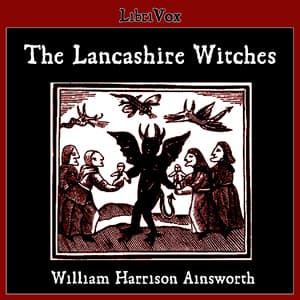

Look, I need to get something off my chest: William Harrison Ainsworth has no idea when to stop a sentence. I'm serious. There are passages in The Lancashire Witches where a single sentence will wander through three subordinate clauses, a Latin invocation, a geographical description of Pendle Hill, and a character's genealogy before arriving — breathless and slightly confused — at a period. And I loved almost every minute of it.
I started this one during a Saturday morning walk along the lakefront with Denise, and she knew within ten minutes that I'd checked out of our conversation entirely. Twenty-five hours is a commitment. That's not a book — that's a relationship. But Ainsworth's 1849 novel about the Pendle witches — Demdike, Chattox, Alice Nutter, the whole infamous crew — earns most of that runtime. Most.
The Dissolution Before the Darkness
Here's what surprised me. The book doesn't start with witchcraft. It starts with the dissolution of Whalley Abbey, which is Ainsworth's way of saying: before we talk about who got hanged, let's talk about what got destroyed. The collapse of the old Catholic order, the redistribution of monastic lands to families like the Asshetons and Nowells — this is the soil the witchcraft grows from. Ainsworth understood something that a lot of modern historical fiction misses: witch trials don't happen in a vacuum. They happen when power shifts and people get scared. I keep coming back to that same idea whenever I revisit Brideshead Revisited — Waugh is also quietly insisting that you understand what was lost before you can understand what the story is actually about.
But — and my students would appreciate this complaint — the introduction is genuinely rough going. Ainsworth spends what feels like hours on historical preamble before the story finds its legs in Book 1. I was grading a stack of sophomore essays on The Crucible (the irony, again, not lost on me) and nearly switched to something else. If you push through, though, the narrative opens up into something genuinely atmospheric. The Forest of Bowland sections have a Gothic weight to them that reminded me of Ann Radcliffe, if Radcliffe had actually visited the places she wrote about.
Andy Minter Deserves Better Than LibriVox's Reputation
Let's talk about Andy Minter, because this man is doing volunteer work at a professional level, and that fact should embarrass some narrators who get paid. His voice has this calm, steady warmth — not actorly, not showy, but deeply attentive to Ainsworth's rhythms. The narrator understands that pause is punctuation. When he hits the trial scenes at Lancaster Castle, there's a restraint in his delivery that actually makes the horror land harder. He doesn't push toward melodrama. He lets the historical record do the work.
Now, one legitimate complaint from listeners: the Latin and French phrases scattered through the text. Minter reads them cleanly enough, but there's no translation offered. If you don't have schoolboy Latin (and who does anymore — not my students, that's for sure), you'll miss context. It's not Minter's fault; it's Ainsworth writing for a Victorian audience that was expected to know their Vulgate from their vernacular. But it does create moments where you're briefly adrift.
The audio quality itself is clean and consistent across twenty-five hours, which for a LibriVox recording is remarkable. Multiple listeners have compared it to commercial productions, and they're not wrong. I've paid for Audible credits that gave me worse.
Why We Still Read About Pendle Hill
This is why we still read the classics — not because they're comfortable, but because they show us how people have always weaponized fear against the marginalized. Demdike and Chattox were real people. Poor, old, female, probably suffering from mental illness or simple poverty. Ainsworth fictionalizes them heavily, gives them genuine supernatural powers in his telling, but there's something underneath his Gothic drama that still reads as honest: these women were crushed by a system that needed someone to blame.
Ainsworth is not Dickens. He's not even Wilkie Collins. His prose can be overwrought, his plotting occasionally circular, his digressions about Lancashire geography the kind of thing that would get a red pen from me on a student paper. But he writes place like few Victorian novelists can — Pendle Hill becomes a character, and the forest scenes have a damp, oppressive quality that audio actually enhances. You hear the weight of those descriptions differently than you read them on a page.
If you loved The Crucible (and I teach it every year, so I'd better love it), this is its spiritual successor — or rather, its spiritual ancestor, written 150 years closer to the actual events. Arthur Miller was working from Salem; Ainsworth was working from Lancaster. Different countries, same machinery of accusation.
Who Gets Assigned This One
Best for: Patient listeners who love historical fiction with genuine period atmosphere. Fans of Victorian Gothic. Anyone interested in the Pendle witch trials who wants more than a Wikipedia summary. And honestly? Anyone who's given up on LibriVox after bad experiences. This will change your mind.
Skip if: You need plot momentum to stay engaged. Twenty-five hours of 19th-century prose with a slow-burn opening isn't for everyone, and there's no shame in that. Also skip if untranslated Latin genuinely bothers you — there's enough of it to be a recurring irritation.
Worth Pausing the Faculty Meeting For
Andy Minter performing Ainsworth is one of those quiet gifts the internet occasionally produces — a skilled reader matched perfectly to material he clearly cares about. The book itself is imperfect, sometimes tedious, occasionally brilliant, and historically important in ways that surprised me. I listened to the final trial and execution scenes while sitting alone in my classroom after hours, papers forgotten, and felt the same chill I felt the first time I taught Miller's courtroom scene to a room full of sixteen-year-olds who suddenly understood that this stuff actually happened.
My students would hate this. I love it.