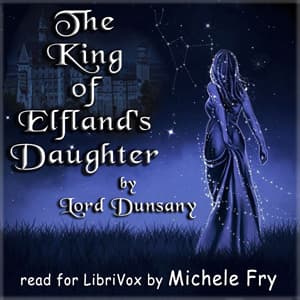

I was walking the lakefront with Denise last Sunday — one of those late October mornings where the fog sits on the water and everything looks like it belongs in a different century — and somewhere around hour two of this audiobook, she turned to me and said, "You haven't said a word in forty minutes." She wasn't annoyed. She could tell from my face I'd gone somewhere else entirely. I had. I'd gone to Elfland.
Lord Dunsany's The King of Elfland's Daughter is a 1924 novel that most people haven't read but that shaped basically everything they love about fantasy. Tolkien read Dunsany. So did Ursula Le Guin. So did Neil Gaiman. And yet the book itself feels nothing like the genre it helped create. There are no quest maps, no prophecies, no chosen ones with destiny complexes. There's a parliament of country folk who ask their lord to bring magic to their village, a young man named Dorel who crosses into Elfland to marry the king's daughter Lirazel, and then — and this is the part that caught me off guard — the real story becomes about what happens when magic tries to live alongside the mundane. Lirazel comes to our world and can't understand why the church bells frighten her. She can't feel time the way we do. And Dorel slowly realizes that getting what you wished for is its own kind of tragedy.
This reminds me of what Hemingway said about prose being architecture, not interior decoration. Dunsany builds with architecture, but his materials are mist and starlight. The sentences in this book don't behave like modern prose. They roll and repeat and circle back on themselves in a way that's closer to oral storytelling — closer to the way someone would tell a fairy tale beside a fire. The phrase "the fields we know" recurs like a refrain, drawing this line between the ordinary world and Elfland that gets thinner and stranger as the book goes on.
The Prose Deserves a Voice That Knows When to Breathe
Here's the thing about narrating Dunsany: you can't rush him. His sentences are built on rhythm, on the way clauses stack and tumble. Michele Fry understands this. Her delivery is lilting and unhurried, and she treats Dunsany's repetitions not as redundancy but as incantation. There's a quality to her reading that feels like she's letting the language do its own work — she's not performing at you, she's channeling something. The narrator understands that pause is punctuation.
Now. Is she perfect? Not quite. The troll — this strange, endearing character who follows Dorel's hunting dog back from Elfland — gets a genuinely distinctive voice, gravelly and bewildered and funny. But beyond that, character differentiation is thin. Lirazel and the various villagers don't sound markedly different from one another, which means in dialogue-heavy passages you're leaning on context clues to track who's speaking. For a book this short (seven hours and change), that's manageable. But if you're someone who needs each character to pop with a unique vocal signature, you'll notice the limitation.
What Fry absolutely nails is tone. This is a book that operates in a register somewhere between prayer and dream, and she matches it. I listened at 1.0x — obviously — and I'd argue this is one of those rare audiobooks where speeding up would genuinely break something. The prose deserves to be savored. Dunsany chose every cadence. Let them land.
What Dunsany Is Really Saying Under All That Starlight
Let's talk about what the author is really saying. Because underneath the fairy-tale surface, this is a book about the impossibility of having it both ways. The villagers want magic, then fear it when it arrives. Dorel wants an immortal bride, then can't bridge the gap between her timelessness and his mortality. The ending — which I won't spoil — doesn't resolve neatly. It aches. It's the kind of conclusion that sits with you on the walk home while your wife asks if you're okay and you say "yeah" but you're still thinking about Dorel standing at the edge of the fields we know. Roy's God of Small Things left me in the same quiet wreckage — that particular kind of ending that doesn't slam a door but just... stops, and leaves you standing in the hallway.
My students would hate this. The pacing is glacial by modern standards. There's no action sequence, no twist, no snarky dialogue. It's a hundred years old and reads like three hundred. I love it.
If you loved Phantastes by George MacDonald, this is its spiritual successor — the same dreamlike wandering, the same sense that you're reading something that existed before the author wrote it down. And if you've ever wondered where Tolkien got the idea that elves should feel alien and sad and slightly terrifying, start here.
Who Should Clear Their Schedule
This is for focused listening. Bedtime might work if you want to drift off inside something beautiful, but honestly, I'd recommend giving it your full attention — a long walk, a quiet room, earbuds in with the grading pushed aside. It's not background material. It asks something of you.
Skip it if you want plot momentum or modern pacing. Skip it if character voices matter more to you than atmosphere. But if you've ever felt that fantasy lost something when it traded wonder for world-building manuals — come back to the source.
Worth Pausing the Faculty Meeting For
This is why we still read the classics. Dunsany wrote a fairy tale that doesn't condescend, a love story that doesn't sentimentalize, and a fantasy that's more interested in what magic costs than what it does. Michele Fry's narration serves it well — not flawlessly, but with the right reverence and the right restraint. At seven hours, it's a weekend commitment that'll stay with you longer than books three times its length.
Principal Martinez, I'm sorry about the budget meeting. But I regret nothing.