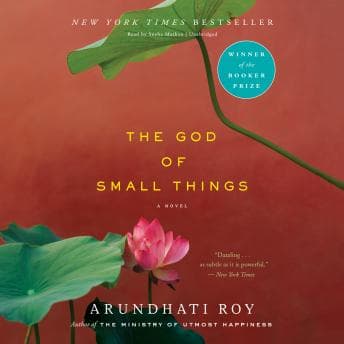

I'm going to be honest with you. I started this audiobook three times before it finally took hold. Three times. And I teach Faulkner to teenagers who think "The Sound and the Fury" is about a Shakespeare adaptation. I'm supposed to be good at this.
But here's the thing about Arundhati Roy's prose—it doesn't want you to understand it immediately. It wants you to surrender to it. And at 11:47 PM, grading yet another essay about how Gatsby was "relatable," I finally stopped fighting and let the Ayemenem river carry me where it wanted to go. My students write about The Great Gatsby like it's a cautionary tale about parties, missing the point entirely—but Roy's book is what happens when you actually understand how class and desire destroy people.
The Love Laws and How They Break You
Roy writes like someone dismantling a clock to show you why time hurts. The narrative jumps between 1969 and 1993 with the casual cruelty of memory itself—you're watching seven-year-old twins Rahel and Estha build a world from the wreckage of their family, and then suddenly you're seeing them as hollow adults, and you understand that something terrible is coming. You just don't know what.
This reminds me of what Hemingway said about the iceberg theory—except Roy shows you the iceberg, then the ship, then the drowning, then loops back to show you the iceberg again from underwater. The non-linear structure isn't a gimmick. It's grief. It's how trauma actually works—not in clean chronological order but in fragments that cut you when you're not expecting them.
My students would hate this. I love it.
Sneha Mathan Knows That Pause Is Punctuation
The narrator gets something crucial about Roy's language: it's meant to be heard. Those invented compound words—"Pappachi's Moth," "Love Laws," the way "Esthappen" and "Rahel" become almost musical—Mathan delivers them with a spare, blunt force that never tips into melodrama.
There's a brutal attack scene that I won't spoil, but Mathan reads it with such devastating restraint that I had to pull over during my lakefront walk. Just stood there by the water, earbuds in, not moving. The prose deserves to be savored, and she knows when to let Roy's words do the violence themselves without adding theatrical emphasis.
I listened at 1.0x because—well, you know my feelings on this—the author chose those words. Roy spent five years writing this book. The least I can do is hear it at the speed she intended.
Why Some Readers Bounce (And Why That's Okay)
I've seen the complaints: "confusing," "fragmented," "couldn't follow the timeline." And I get it. This is not a book for background listening. Not a book for the gym. This is a book that requires you to sit with discomfort—the discomfort of a caste system that punishes love, of children who see too much, of a family that destroys itself because the alternative is unthinkable.
If you loved "Beloved" or "The Sound and the Fury," this is their spiritual successor—a book that trusts you to hold multiple timelines in your head while your heart breaks. If you need linear plot and clear resolution, this will frustrate you. Roy isn't interested in making things easy. She's interested in making things true.
Who This Is For (And Who Should Walk Away)
This is for readers who believe that how a story is told matters as much as what happens. For people who find beauty in devastation. For anyone who's ever loved someone they weren't supposed to love and understood, viscerally, what Roy means when she writes about the Love Laws—"the laws that lay down who should be loved, and how. And how much."
Skip it if you need action to stay engaged. Skip it if you're looking for something light after a hard week. Skip it if you can't handle content warnings for violence, abuse, and sexual content—Roy doesn't flinch, and neither does Mathan.
Worth Pausing the Faculty Meeting For
Twenty years ago, this book won the Booker Prize and introduced the world to a voice that sounds like no one else. Twenty years later, listening to it while pretending to pay attention to budget presentations (sorry, Principal Martinez), I understand why it endures.
The God of Small Things is about how the big things—history, caste, colonialism—crush the small things: a child's love, a mother's hope, the brief impossible happiness of two people who shouldn't touch. It's about how we carry our losses forward, and how they carry us.
Eleven hours and forty-six minutes. Worth every second of lost sleep.