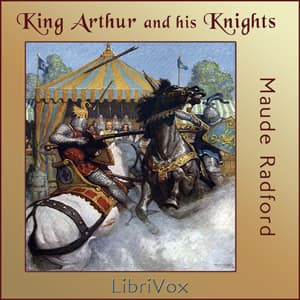

Look, I know what you're thinking. "Tom, you read Brandon Sanderson books that are longer than some people's doctoral dissertations. Why are you listening to a four-hour children's retelling of Arthurian legend?" And honestly? Because sometimes you need a palate cleanser between 50-hour epic fantasy series. Also because my thesis advisor sent me a passive-aggressive email about "refocusing on fundamentals" and I decided to interpret that as creatively as possible.
Here's the thing though—everyone talks about King Arthur like it's this universally known mythology, but when you actually press people? They know Excalibur, they know the Round Table, maybe they've got some vague Monty Python references rattling around. Maude L. Radford's 1903 retelling strips away all the medieval romance bloat and gets to the actual bones of these stories. And those bones? Pretty solid D&D campaign material, honestly.
The Gateway Drug to Arthurian Obsession
Radford wrote this specifically for younger readers, and you can feel that in how she structures the tales. Each knight gets their moment—Lancelot's impossible devotion, Gawain's honor, Percival's quest for the Grail. She doesn't drown you in courtly love conventions or spend forty pages on tournament descriptions. The pacing moves like someone who respects that kids (and thesis-procrastinating grad students) have limited attention spans.
What struck me is how much of modern fantasy owes to these specific story beats. The mentor who dies too soon. The fellowship that fractures from within. The magic sword that chooses its wielder. Sanderson didn't invent the Cosmere from nothing—these archetypes have been running in the background of Western storytelling for centuries. Blood Meridian strips away different kinds of romance—the American frontier myth—to expose similarly brutal archetypal bones. Hearing them in their simpler form is like looking at the source code.
Robin Cotter Does the Heavy Lifting
I went into this with zero expectations for the narration—it's a LibriVox recording, which means volunteer readers with varying levels of experience. Robin Cotter delivers something pleasantly straightforward. No dramatic vocal gymnastics, no attempt to give every knight a distinct accent. Just clear, measured reading that lets the stories breathe.
Is it Steven Pacey? Absolutely not. (Nothing is Steven Pacey except Steven Pacey.) But for what this is—an accessible introduction to Arthurian legend—the narration works. Cotter maintains good energy across the four-hour runtime without that droning quality that can plague volunteer audiobooks. The audio quality is clean, no weird room echo or background noise that sometimes shows up in public domain recordings.
Who Should Queue This Up (And Who Should Pass)
Here's where I'll be honest: if you're already deep in Arthurian scholarship, this isn't going to teach you anything new. Radford simplifies and sanitizes—the Lancelot-Guinevere situation gets the G-rated treatment, and some of the darker Welsh mythology roots are completely absent. This is King Arthur as bedtime story, not King Arthur as complex medieval literature. Skip it if you want the gritty, morally complicated version.
But that's exactly why it works for certain listeners. Got kids who are starting to get into fantasy? This is perfect. Want something light for background listening while you're doing dishes? Totally fine. Need to understand the basic beats before tackling T.H. White or Malory? This is your on-ramp.
For me, I listened while organizing my board game shelf (yes, I have enough games that this requires dedicated time, no I don't want to talk about it). The episodic structure means you can pause between tales without losing any narrative thread. Each knight's story is essentially self-contained.
The Magic System Is... Well, It's Merlin
Okay, I can't help myself—the magic in Arthurian legend is frustratingly vague by modern fantasy standards. Merlin just does things. There's no hard magic system, no cost, no rules. He appears, solves problems with wizard powers, disappears. My D&D group would riot if I ran magic this loosely.
But there's something almost refreshing about that after years of meticulously constructed Sanderson systems. Magic as mystery rather than science. The sword in the stone works because it should work, because Arthur is the rightful king. No explanation needed. Sometimes fantasy doesn't need to explain itself.
Roll For Initiative, I Guess
At 4 hours and 20 minutes, this is basically a long podcast. It's free through LibriVox, which means you've got zero financial risk. If you've never actually sat down with the Arthurian legends in any structured way, this is a surprisingly good introduction. Radford knew how to tell a story, and a century later, these tales still have their hooks.
Will this replace my epic fantasy audiobook habit? Obviously not. But as a quick listen between massive series, or as something to share with younger fantasy fans in your life, it's worth the time. My thesis remains unwritten, but at least now I can articulate exactly why the Once and Future King archetype keeps showing up in everything I read.
Mom, if you're reading this: I'm being productive. This counts as research. Probably.