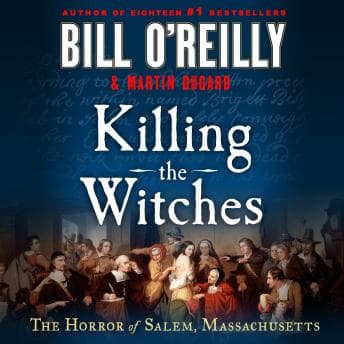

What happens when a community decides fear is more valuable than facts? I've seen it happen in combat zones—mass panic spreading faster than accurate intel—but watching it unfold in 1692 Salem through this audiobook hit different. Maybe because these weren't foreign fighters making bad calls. These were Americans. Our ancestors. And they executed twenty people based on spectral evidence and teenage hysteria.
Let me cut to the chase: O'Reilly and Dugard deliver about half a book on the Salem witch trials and half a book on... well, everything else. The Puritans. The founding fathers. The Constitutional Convention. Modern exorcism cases. It's a broader mission scope than the title suggests, and depending on your expectations, that's either a feature or a bug.
When the Intel Gets Scattered
Here's where it lost me for stretches. I'm driving through Hill Country, Ranger's asleep in the back seat, and I'm expecting to stay locked on Salem—the accusations, the trials, the hangings. Instead we're suddenly talking about the influence of Puritan tradition on the Revolutionary War. Look, I get the connection. The through-line makes sense from a historical perspective. But the title says "Killing the Witches," not "A Comprehensive Survey of Puritan Influence on American Democracy."
The Salem sections themselves? Those are solid. O'Reilly and Dugard know how to build tension, and the trial details are genuinely disturbing. Watching community leaders—ministers, judges, supposedly educated men—accept "spectral evidence" as proof of witchcraft... it's a case study in how groupthink can override every reasonable instinct. I've seen similar dynamics in military units that went sideways. Once fear takes hold, logic becomes the first casualty.
But then we pivot to modern possession cases, including the real story behind The Exorcist, and I'm honestly not sure what mission we're on anymore. Is this a historical deep-dive or a cultural survey? The authors clearly did their homework on the broader implications, but the structure feels like it was designed by committee.
Petkoff Carries the Load
Robert Petkoff's narration is the tactical advantage here. Clean, professional, thriller-pacing that keeps you engaged even when the content wanders. He's got that news-anchor clarity—which makes sense given O'Reilly's background—but with enough dramatic range to make the trial scenes genuinely tense.
No character voices to speak of, which is fine for narrative nonfiction. What Petkoff does well is maintain momentum. Nine hours is a significant commitment, and he never drags. I listened at my usual 1.25x and it held together perfectly. The Macmillan production quality is exactly what you'd expect—clean audio, no weird artifacts, professional all the way through.
I couldn't find much about Petkoff's background beyond his work on the Killing series, but based on this performance, the guy knows how to handle historical material without making it sound like a documentary voiceover. There's actual energy here.
Who Should Queue This Up (And Who Should Skip)
If you're a fan of the Killing series, you know what you're getting—queue it up. If you want a focused, start-to-finish account of Salem specifically, adjust your expectations or look elsewhere. And if you can't stand narrative tangents into Constitutional history and modern exorcism cases, this one's going to frustrate you.
The Debrief
What you're getting is more like a reconnaissance sweep across American religious and political history, with Salem as the jumping-off point. The connections O'Reilly and Dugard draw are legitimate—Puritan influence really did shape the founding documents—but the execution feels scattered. Narrative of the Life of Frederick Douglass offers a more focused look at how religious doctrine was weaponized in early America, though from a very different angle.
The last chapters on modern "possession" cases and contemporary witch hunts (including the social media variety) are either fascinating or frustrating depending on what you came for. I found myself wishing they'd picked a lane. Either give me the definitive Salem audiobook or give me a broader cultural analysis, but trying to do both leaves neither fully satisfied.
The core Salem material is compelling, though. The descriptions of young girls convulsing in church, the escalating accusations, the absolute certainty of the accusers—it's genuinely unsettling. And there's a lesson here about how quickly communities can turn on themselves when fear overwhelms reason. 48 Laws of Power explores similar dynamics—how fear and manipulation can override rational judgment when power structures are at stake. (I've seen that lesson ignored in plenty of modern contexts, but that's a different debrief.)
Mission accomplished? Partially. Petkoff's narration is excellent, the production is clean, and the Salem sections deliver. But the structural choices kept pulling me out of the story. If you're new to O'Reilly's historical work, just know that "narrative history" here means "we're going to wander." Ranger slept through most of it, which is neither an endorsement nor a criticism—that dog will sleep through anything.






![Steve Jobs [unabridged audiobook] audiobook cover](/_next/image?url=https%3A%2F%2Fcovers.audiobooks.com%2Fimages%2Fcovers%2Ffull%2F9788499923406.jpg&w=1920&q=75)