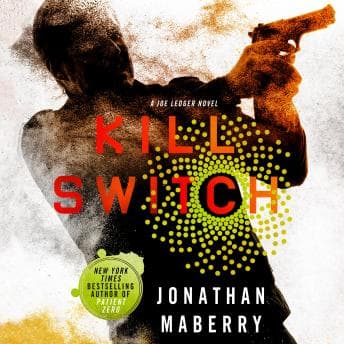

Around the halfway mark of Kill Switch, there's a moment where Joe Ledger faces something that made me actually pull my earbuds out and stare at my phone like it had betrayed me. Not because the narration faltered—Ray Porter was doing exactly what he does best—but because Jonathan Maberry had just combined a bioweapon apocalypse with something crawling out of Lovecraft's fever dreams, and my brain needed a second to catch up.
This is book eight in the Joe Ledger series, and Maberry has clearly decided that "restraint" is a word for other authors. The premise sounds almost quaint when you summarize it: terrorists want to crash the power grid and release a plague in the darkness. Simple enough, right? Except nothing in a Joe Ledger novel stays simple. By the time you're a few hours in, you're dealing with conspiracy layers that would make a paranoid's corkboard look minimalist, and creatures that suggest the real threat isn't just losing electricity—it's what might be waiting in the dark when the lights go out.
Ray Porter Knows Exactly What He's Doing
Porter's narration here isn't just good; it's the kind of performance that makes you understand why some readers refuse to experience this series any other way. His voice work for different characters never bleeds into caricature, which is impressive given the size of the cast. Ledger himself comes across as appropriately world-weary but never defeated, and Porter nails the balance between action hero and deeply traumatized operative. The pacing he brings to combat sequences had me speeding up on the treadmill without realizing it—there's an urgency in his delivery that's almost physical. That same relentless momentum drives Outsider: A Novel, though it leans harder into the psychological dread.
What struck me most was how Porter handles the horror elements. Maberry writes scenes that could easily tip into schlock, but Porter's measured intensity keeps everything grounded just enough to be genuinely unsettling rather than campy. When things get weird—and they get very weird—his voice maintains that thread of disbelief that mirrors what any sane person would feel. It's a subtle thing, but it makes the Lovecraftian intrusions feel earned rather than grafted on.
The emotional beats land harder than I expected for a thriller. There's real weight to the relationships here, and Porter gives them room to breathe even when the plot is screaming forward. A few quieter moments between characters hit with surprising force, largely because Porter doesn't oversell them. He trusts the material, and the material rewards that trust.
That Audio Glitch (And Why It Doesn't Matter)
Now, about that audio hiccup near the end—yes, it's there, and yes, you'll notice it. The narrator's voice suddenly shifts clearer and slightly louder for a brief stretch, like someone bumped the levels in post-production. It pulled me out of a tense moment, which was frustrating. But calling it a dealbreaker would be absurd given the seventeen-plus hours of otherwise clean, professional audio that precedes it. Think of it as a speed bump on an otherwise smooth highway.
The ending itself has divided some listeners, and I can see why. Maberry doesn't wrap everything in a neat bow, and certain threads feel like they're being saved for future installments rather than resolved here. If you need closure, this might leave you slightly hungry. Open Season does something similar with its series setup, planting threads that clearly extend beyond the first book. Personally, I appreciated that it didn't feel artificially conclusive—this is clearly a series that's going somewhere, and Kill Switch feels like a crucial waypoint rather than a destination.
Maberry Writes Like He's Running Out of Time
His style is relentless in the best way. He's not interested in letting you get comfortable. Every time you think you understand the shape of the threat, he adds another angle. The conspiracy elements could easily become exhausting, but they're parceled out with enough reveals to keep the forward momentum going. And when the action kicks in, it kicks hard—Maberry writes violence with a precision that feels researched rather than imagined.
For commuters and long-drive listeners, this is nearly ideal. The chapters are structured to give you natural stopping points, but good luck actually stopping. I blew past my exit more than once because I needed to know what happened next. At nearly eighteen hours, it's a commitment, but the pacing earns that runtime.
Who's This For (And Who Should Run)
A word of caution: this isn't gentle listening. The violence is graphic, the horror elements are genuinely disturbing at points, and the stakes involve mass casualties described in unflinching detail. If you're looking for a cozy thriller, look elsewhere. But if you want something that grabs you by the throat and doesn't let go until the final chapter—and you don't mind your military thrillers seasoned with cosmic horror—Kill Switch delivers with brutal efficiency. Skip it if you need standalone stories or can't stomach body horror mixed with your action.
The Throat-Grab Verdict
Ray Porter and Jonathan Maberry have clearly found their rhythm together, and it shows. This is the kind of audiobook that reminds you why the format exists—not just as a convenience, but as a genuine way to amplify what's already on the page.