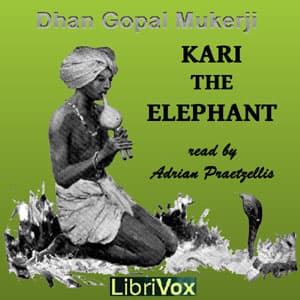

Okay, so here's my complaint: why did nobody tell me about Dhan Gopal Mukerji before now? I'm supposedly this well-read fantasy nerd who knows all the classic adventure stories, and yet somehow a Newbery Medal-winning author from the 1920s who wrote about a boy and his elephant completely escaped my radar. I found this while procrastinating on my thesis (shocking, I know) and figured a two-and-a-half hour listen couldn't hurt. My advisor would disagree. My advisor can wait.
Look, this isn't epic fantasy. There's no magic system to diagram, no Sanderlanche to build toward. But there's something here that scratches a similar itch—the world-building. Mukerji writes about India with the kind of lived-in detail that you just can't fake. The jungle, the river, the way elephants are trained and cared for—it's not info-dumping, it's immersion. That same kind of lived-in authenticity is what made My Confession work so well—different setting, same commitment to making the world feel real. My D&D group would love this as inspiration for a jungle campaign setting, honestly. The relationship between the narrator boy and Kari feels like the best kind of animal companion story, except it's rooted in real cultural practices rather than fantasy tropes.
When Elephants Feel More Real Than Dragons
Here's the thing about classic children's literature—it can go one of two ways. Either it holds up with this timeless quality, or it feels dusty and preachy. Kari the Elephant lands firmly in the first camp. Mukerji's writing is poetic without being purple, accessible without talking down to you. There's this warmth to how he describes the bond between boy and elephant that genuinely got to me. (Yes, I have feelings. No, I don't want to talk about it.)
The adventures themselves are pretty straightforward—training Kari, rescuing a drowning boy, dealing with jungle dangers—but that simplicity is actually refreshing. Sometimes you don't need seventeen subplots and complex political intrigue. Sometimes you just need a kid and his elephant learning to trust each other. The progression is satisfying in a quiet way. It's not leveling up or gaining new abilities, but you feel the relationship deepening chapter by chapter.
Adrian Praetzellis Nails the Vibe
I couldn't find much about Adrian Praetzellis online beyond his LibriVox work, but based on this performance? The guy knows what he's doing. His voice is clear and warm—exactly what you want for a children's classic. He doesn't try to do elaborate character voices or dramatic flourishes, which would've felt wrong for this material. Instead, he reads it like a grandfather telling you a story he genuinely loves. The pacing is spot-on for a bedtime listen or a short commute.
Fair warning: if you're used to full-cast productions or narrators doing fifteen distinct accents, this might feel understated. It's a LibriVox recording, so we're talking clean volunteer work, not Audible studio polish. But for a story this intimate and quiet, the straightforward approach works. Steven Pacey walked so other narrators could run, sure, but sometimes you don't need someone running. Sometimes you need someone sitting by the fire.
Roll for Animal Handling (Or Just Press Play)
If you've got kids who are into animals, this is a no-brainer. It's short enough to hold attention, adventurous enough to stay engaging, and educational about Indian culture without being a textbook. Parents looking for something to listen to together during car rides—this is your jam.
But here's the thing—I don't have kids. I'm a grad student who should be writing about procedural generation algorithms. And I still enjoyed this. There's something about the simplicity and sincerity that feels like a palate cleanser after listening to seventeen epic fantasy doorstoppers.
Skip this if: you need constant action or modern pacing. The prose has that older literary style—not archaic, but definitely from another era. Some people find that charming. Some people find it slow. I'm in the charming camp, but your mileage may vary.
At two hours and change, there's basically no risk here. It's free on LibriVox, it's well-narrated, and it's a piece of literary history from an author who deserves way more recognition. Mukerji was the first successful Indian author in American letters, won a Newbery, and somehow isn't on everyone's radar. That's a crime, honestly.
I listened to this instead of writing my thesis. Worth it.