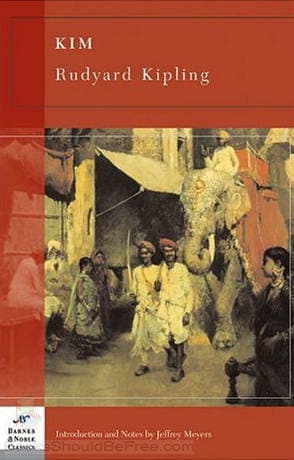

Everyone told me this was a classic I had to read. Nobel Prize winner, foundational spy novel, beloved for over a century. And I'm sitting there thinking—okay, but it's 13 hours long and set during the British Empire. That's a lot of commitment for a busy mom who mostly reads contemporary romance.
I was wrong. So wrong.
The Slow Start Is Real (But Stick With It)
Let me be honest: the first hour or two? I almost bailed. Kipling's descriptions can run long—like, inventory-list long. I'm folding laundry during nap time thinking "When does the adventure actually start?" But something kept me going. Maybe it was the narrator's voice for the old Tibetan lama. Maybe it was the street-smart kid at the center of it all. By hour three, I was hooked.
Kim himself is this scrappy Anglo-Indian orphan running wild through the streets of Lahore, and watching him get pulled into espionage while also serving as a companion to this gentle, wise holy man searching for enlightenment? It's such an unexpected combination. Adventure and philosophy. Spy games and spiritual journeys. I didn't expect to care about a lama's quest for a sacred river, but here I am.
Adrian Praetzellis Deserves All The Credit
Here's the thing about 13-hour audiobooks with Victorian prose—they live or die by the narrator. Adrian Praetzellis absolutely makes this work. His lama voice is so distinctive that I caught myself—I'm not kidding—trying to imitate it when explaining something to Lucas. (He was very confused. Fair.)
The character differentiation is genuinely impressive. Kim sounds like a quick-witted kid. The lama has this gentle, measured wisdom. The various spies and soldiers and merchants all get their own distinct voices, and he keeps them consistent across THIRTEEN HOURS. That's harder than it sounds. Trust me, I've listened to plenty of audiobooks where the narrator forgets what voice they gave someone by chapter four.
What really got me was how he handles the emotional moments. There's real warmth between Kim and the lama, this unlikely friendship across generations and cultures, and Praetzellis brings that out without getting saccharine about it.
The Imperialism Thing (We Should Talk About It)
I can't write this review without mentioning: yes, this is a book written in 1901 about the British Empire in India, by a man who was very much a product of that empire. There are moments that made me wince. The "Great Game"—Britain vs. Russia for control of Asia—is presented as this exciting adventure, and... well, colonialism wasn't actually an adventure for the people being colonized.
I'm not saying you can't enjoy it. I clearly did. But if you're listening with older kids or just want to know what you're getting into, the perspective is very much of its time. My book club would have a field day discussing this one. (If I ever have time for book club again.)
Survived 47 Pauses And Still Made Sense
Here's my highest praise: I listened to this over two and a half weeks, in 20-minute chunks during school drop-off, during nap time when Sophie actually cooperated, during my sacred car-in-the-garage time. That same fragmented listening style worked surprisingly well with Comstock Lode, another sprawling historical epic that rewards patience. I got interrupted constantly. Baby needed me. Emma had a crisis about her art project. Lucas wanted to know why birds don't fall when they sleep.
And I never lost the thread.
Kipling's storytelling is episodic enough that you can pick it up after a day away and still know where you are. The characters are distinct enough (thanks in large part to Praetzellis) that you're not confused about who's talking. For a book this long and this old, that's remarkable.
Who Gets the Most Out of This
Perfect for anyone who wants something more substantial than their usual listen—parents who grew up loving adventure stories and want something with actual depth, listeners who can handle a slow build for a big payoff, history buffs interested in colonial India (with appropriate critical distance). Maybe skip if you need fast pacing from page one, Victorian prose makes you want to throw things, or you have zero tolerance for dated perspectives on empire.
Worth the Car-in-the-Garage Time
Look, this isn't my usual read. It's not a rom-com with a guaranteed happy ending. It's not something I'll finish in a week. But sometimes you need to stretch a little, and Kim rewarded me for it. The friendship between a street kid and an old monk, the adventure of espionage in a world of trains and bazaars and mountain passes, the way Praetzellis makes it all feel alive—it worked.
I listened at 1x for this one. Didn't want to rush it. That's saying something.