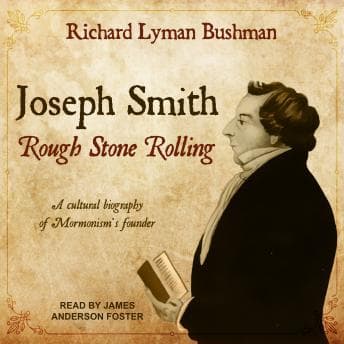

Is it possible to write a biography of a prophet that satisfies both the skeptic and the believer? That's the tightrope Richard Bushman walks here, and honestly, I expected him to fall off about hour three. I listened to this massive 29-hour beast mostly while grading a stack of AP English essays on The Scarlet Letter—which felt appropriately ironic given the Puritanical judgment I was dishing out with my red pen.
The "Believing Historian" Paradox
Usually, biographies of Joseph Smith fall into two camps: hagiography where the man can do no wrong, or exposé where he's a charlatan from page one. Bushman, a practicing Mormon and a legit Columbia historian, tries to do both. And—mostly—it works. He calls it "Rough Stone Rolling" for a reason. He gives you the financial disasters, the Kirtland Safety Society anti-banking fiasco, and the messy, uncomfortable reality of polygamy. But he frames it all through a lens of genuine religious struggle rather than cynical con-artistry. My students would hate this. There are no easy answers, just a lot of primary source documents and 19th-century theology. That uneasy respect for faith under pressure is also what kept me turning pages in Blood of the Covenant, even when the history got ugly. It requires patience I usually reserve for Faulkner.
James Anderson Foster as Your Designated Driver
Foster has the kind of voice that belongs in a mahogany-paneled library. He's not doing "voices" in the theatrical sense—thank God, because if he tried a distinct accent for every 1830s frontier farmer, I would've thrown my phone into Lake Michigan. Instead, he uses slight shifts in cadence to separate Bushman's academic analysis from the archaic, biblical syntax of Smith's revelations. It's a subtle performance. When you're listening to a book this long, you don't want fireworks; you want stability. Foster is the designated driver of narrators. He gets you home safely without making a scene.
Why It's Worth The Slog
Look, this isn't a beach read. It's dense. We get into the weeds of theological evolution that makes Moby Dick's whale taxonomy chapters look thrilling. But if you actually care about American history—not the polished version, but the weird, spiritual, violent reality of the frontier—this is essential. Different shelf, same bruised country: All Over But the Shoutin' gave me that same sense that America is best understood through its rough edges. It reminds me that history is rarely about heroes and villains; it's about complicated people making noise in a quiet room. Denise caught me listening to the section on the Nauvoo period while I was doing dishes and asked if I was converting. I told her no, I just appreciate a guy who writes with this much texture about a subject that usually makes people stop thinking critically.
Is it too long? Probably. Could the middle section about the Missouri conflicts have been trimmed? Definitely. But like a good Russian novel, the weight of it is part of the point.
Who Should Queue This Up (And Who Shouldn't)
If you want American religious history that doesn't condescend to believers or let Smith off the hook, this is your book. Skip it if you need clear heroes and villains, or if 29 hours of 19th-century theology sounds like punishment rather than education.
Class Dismissed
Bushman wrote the biography Joseph Smith probably deserves—flawed, fascinating, and frustratingly human. It won't convert you to anything except maybe a deeper appreciation for how messy American history actually was.





![Steve Jobs [unabridged audiobook] audiobook cover](/_next/image?url=https%3A%2F%2Fcovers.audiobooks.com%2Fimages%2Fcovers%2Ffull%2F9788499923406.jpg&w=1920&q=75)