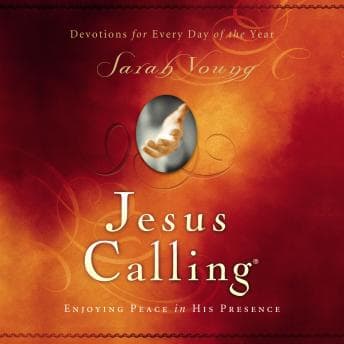

Look, I need to get something off my chest: I am not the target audience for this book. I'm an English teacher who spends his Sundays arguing with Denise about whether we should try the new Ethiopian place or rewatch The Wire. My faith life is real but private, and I've always been suspicious of devotionals that presume to speak in Christ's voice. That's a bold narrative choice — bolder than anything Faulkner ever tried, and Faulkner once wrote an entire novel from the perspective of a man with an intellectual disability. So when Sarah Young writes 365 entries as if Jesus is talking directly to you, my literary hackles go up. Who authorized this point of view?
But here's the thing. I listened to this during a string of late November nights — grading junior essays on The Great Gatsby at the kitchen table, red pen in hand, earbuds in, Denise already asleep upstairs. And at 11:30 PM, when you've just read the fourteenth student paper claiming Gatsby "just wanted to be rich," there's something disarming about a calm voice telling you to rest in peace and stop striving. I didn't expect it to land. It landed.
The Voice-of-God Problem (and How the Narrators Handle It)
Bill Russell reads the devotional entries — the Jesus-voice sections — and Nan Gurley handles the scripture readings and reflective prompts. This is where the production gets interesting and also where it stumbles. Russell brings a warm, measured baritone that genuinely works for the quieter, more reassuring entries. When the text says something like "I am with you and for you," his delivery feels like a steady hand on your shoulder. Not pushy. Present.
But — and this is a real but — there are stretches where Russell dials the drama up to about a seven when the material calls for a three. Some of the shorter devotional entries are simple, almost whispered reassurances, and his voice swells into this achingly theatrical register that pulled me right out of the moment. I kept thinking: this is a man reading a love letter like he's performing King Lear. One listener I came across said they couldn't finish the audiobook because of it, and I get that. I pushed through, but I felt it.
Nan Gurley, by contrast, is the steadier presence. Her scripture readings are clean, unhurried, and she lets the Biblical language do its own work. The narrator understands that pause is punctuation — and Gurley proves it every time she reads a Psalm passage and just... waits. Lets it breathe. I wished she had more of the load, honestly.
The musical scoring is subtle background instrumentation — soft piano, some strings — and it walks the line between "worship album" and "spa lobby" without falling too far either way. It works for bedtime listening. It would drive you insane on a morning commute.
What Sarah Young Is Really Doing Here
Let's talk about what the author is really saying — or rather, how she's saying it. Young's devotional entries are short, rarely more than a few minutes each, and they're structured around a single idea per day: trust, gratitude, surrender, presence. The prose is simple. Almost aggressively simple. My students would hate this. Actually, no — my students might love this, because there's nothing to annotate. Every sentence means exactly what it says.
And that simplicity is the point. This isn't theology. It's not exegesis. It's a daily practice of hearing the same core messages — you are loved, stop worrying, I'm here — repeated in slightly different configurations across 365 days. The updated and expanded edition adds true stories and fuller scripture readings, which give the entries more texture than the original. Without those additions, the repetition might feel like spiritual wallpaper. With them, it feels more like a ritual. And rituals only work if you show up for them.
The second-person-as-Jesus conceit will either comfort you or make you deeply uncomfortable. There's no middle ground. If you believe Young is faithfully channeling scripture into accessible daily language, this will feel like a conversation with the divine. If you find the premise presumptuous — and plenty of serious Christians do — no amount of warm narration will fix that for you.
Who This Is For (and Who Should Keep Walking)
This is built for daily devotional listeners who want a structured quiet time, especially at night or early morning. It's not a book you binge. Listening to more than two or three entries in a row flattens the effect — like eating an entire box of communion wafers. (Forgive me.) One entry per day, ideally with silence after. That's how it works.
Skip this if you prefer your faith intellectually rigorous or theologically complex. Timothy Keller's Prayer: Experiencing Awe and Intimacy with God is where I'd point those people — it gave me the theological density I kept wanting here, and I'll admit the narrator made me feel considerably less like I was being tucked in. Skip it if dramatic male narration makes you twitchy. And definitely skip it if you're looking for something to hold your attention during faculty meetings — this will put you to sleep faster than Principal Martinez's quarterly budget review. (Which, again, I was absolutely paying attention to.)
But if you want something gentle and repetitive in the best sense — a daily reminder delivered in a human voice that you are not carrying everything alone — this does that job. It's not literature. It's practice. And sometimes practice is what you need at 11:30 PM with a stack of ungraded essays and a tired heart.
Worth Pausing the Red Pen For
I came in skeptical and left... not converted, exactly, but softer. The prose deserves to be savored in small doses, and Gurley's scripture readings genuinely moved me more than once. Russell's dramatic tendencies kept this from being a seamless listen, but the production quality is solid and the musical scoring helps more than it distracts. For the right listener, in the right moment, at the right volume — this is a companion, not a performance.