
What happens when you spend 15 hours inside the head of a small-town barber who never really goes anywhere or does anything particularly dramatic?
Honestly? You come out the other side wondering why you've spent your entire career optimizing for throughput when maybe the point was something else entirely.
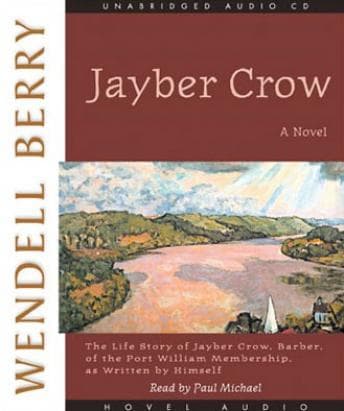
I started Jayber Crow on a Monday morning, 6:12 AM, packed Caltrain, and I almost switched it off by the second stop. The pacing is - look, I need to be upfront about this - glacial by my usual standards. I listen at 1.5x minimum. I bumped this one down to 1.25x by chapter three because Paul Michael's narration has this quiet Kentucky cadence that you genuinely lose if you speed it up too much. It's like trying to fast-forward through someone's grandfather telling you about the time he fell in love. You can, but you're missing the whole point.
The Anti-Optimization Book
Here's what got me. I spend my days debugging distributed systems - finding the failure points, reducing latency, making things faster and more efficient. Jayber Crow is basically the inverse of my entire professional existence. This is a man who cuts hair in the same shop for decades, watches the same families cycle through births and deaths, and falls in love with a woman he never tells. There's no pivot. No growth hack. No exit strategy.
And Berry writes about land and farming and the slow erosion of rural community with the kind of precision I wish I saw in technical documentation. When Jayber describes how the farmers around Port William start abandoning sustainable methods for industrial agriculture, it reads like watching someone introduce technical debt into a perfectly functioning system. You know it's going to break. You can see exactly how. Nobody listens.
The religious and philosophical passages are real, and I'll be honest - some of them hit and some of them felt like Berry was standing on a soapbox. There are stretches where Jayber's seminary reflections on doubt and faith go on long enough that I'd zone out, realize I'd missed four minutes, and have to rewind. The only other time I've rewound that many times through religious wrestling was Bible (KJV) 18: Job - different context entirely, but that same quality of suffering rendered so plainly it demands your full attention. On a crowded train at rush hour, that's a problem. This is not a book you can half-listen to while scrolling Slack notifications.
Paul Michael Earns That Quiet Kentucky Air
Paul Michael isn't Ray Porter (nobody is Ray Porter), but he does something really smart here. His voice ages with Jayber - the young orphan sounds tentatively curious, and by the time Jayber's an old man reflecting back, there's this worn-in warmth that feels like a favorite jacket. He keeps the Kentucky accent subtle enough that it doesn't become a performance piece, but present enough that you never forget where you are. There's a gentleness in how he handles Jayber's unrequited love for Mattie - he never oversells the emotion, just lets it sit there, which honestly makes it hit harder.
One quirk: the pronunciation of local Kentucky place names apparently isn't always spot-on (Versailles gets the standard pronunciation treatment rather than the local Kentucky way), which I wouldn't have caught but will definitely bother anyone from the area.
Who This Is Actually For (and Who Should Run)
Perfect for: Dedicated listening sessions, long flights, weekend mornings with coffee. Skip for: packed commutes where you can't focus, anyone who needs plot momentum to stay engaged, anyone allergic to philosophical or religious reflection.
If you love Marilynne Robinson's Gilead or you've ever wondered what it would feel like to sit on a porch and watch an entire way of life disappear in real time - this is your book. If you picked up Project Hail Mary because you wanted a puzzle to solve, this will feel like watching paint dry. Beautiful paint. Meaningful paint. But paint.
I finished this across about 12 commutes (longer than usual because of the speed adjustment and the rewinds), and I kept thinking about it during my actual work day, which is either the sign of a great book or a sign that I need more sleep. Probably both.
Kevin asked me what I was listening to and I said "a book about a barber who's in love with someone for 30 years and never says anything" and he just stared at me like I'd lost my mind. Fair. But there's this moment where Jayber realizes that his love doesn't require reciprocation to be real - that faithfulness itself is the whole reward - and I sat with that for three stops past Mountain View.
The ROI on this audiobook is weird. It won't teach you anything actionable. It won't optimize your morning routine. It might make you look out the train window for a minute instead of checking your phone, and honestly, that might be worth more.