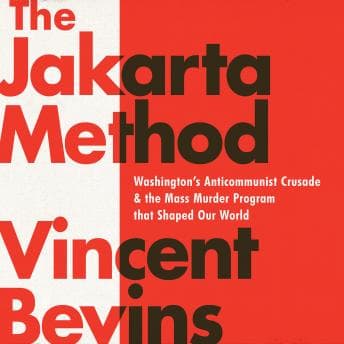

Some books make you angry. This one made me sit in my truck in a client's parking lot for an extra twenty minutes, engine off, just staring at the steering wheel.
Let me cut to the chase: Vincent Bevins has written one of the most important Cold War histories I've encountered, and it's one that most Americans - including this Army Colonel with three combat deployments - never learned. The "Jakarta Method" wasn't a diplomatic strategy. It was a blueprint for mass murder, exported from Indonesia to Latin America and beyond, with American fingerprints all over it.
The Intel Brief You Never Got
Bevins structures this like a proper after-action report. He starts with Indonesia in 1965, where the U.S. government helped the Indonesian military systematically eliminate roughly one million civilians - members and suspected sympathizers of the PKI, the Indonesian Communist Party. Not armed combatants. Civilians. Teachers, union organizers, ethnic Chinese, anyone whose name appeared on lists the CIA helped compile.
What hit me hardest was Bevins' interview work. He tracked down survivors across twelve countries - people who watched their neighbors dragged away, who hid in rice paddies, who lost entire families. These aren't statistics. They're testimonies. And the way he weaves recently declassified documents with these firsthand accounts creates something prosecutors would call an airtight case.
The "method" part is what really twists the knife. Once Indonesia proved you could liquidate a leftist movement through mass violence and the world would essentially look away, the playbook went global. Brazil, Chile, Argentina, Guatemala. "Jakarta is coming" became a threat spray-painted on walls in Santiago. They knew what it meant.
Tim Paige Does the Heavy Lifting
Ten hours of documented atrocities requires a narrator who can handle the weight without being melodramatic. Paige mostly delivers. His pacing is measured, almost clinical at times - which works for this material. You don't need dramatic flourishes when you're describing death squads.
He stumbles on some Indonesian and Portuguese names. Not constantly, but enough that I noticed. When you're honoring the dead by naming them, pronunciation matters. It's a minor complaint against otherwise solid work, but in a book this serious, those small errors feel disrespectful to the survivors Bevins interviewed.
Where It Lost Me - Briefly
Bevins clearly has a political perspective, and he doesn't hide it. Some listeners will find this refreshing. Others will call it bias. I've read enough military history to know that "objective" accounts of covert operations don't really exist - everyone's got an angle. Autobiography of Benjamin Franklin taught me that even the Founders understood the value of transparency over pretense. At least Bevins is upfront about his.
The middle section covering Latin American operations occasionally feels like a catalog of horrors without the same narrative drive as the Indonesia chapters. Understandable given the scope, but my attention drifted during a few stretches around hour six. Not enough to lose the thread, but enough to notice.
Why This Matters Now
I spent 25 years believing I understood American foreign policy. I knew we'd made ugly choices during the Cold War. Containment required hard decisions. But there's a difference between supporting authoritarian regimes and actively facilitating genocide-scale violence against unarmed civilians.
Bevins isn't writing anti-American propaganda. He's documenting what happened, using American sources, American documents, American officials' own words. That's what makes it so difficult to dismiss. You can't call it enemy disinformation when the evidence comes from Langley.
Ranger sat through this one with me on a long drive to Houston. I don't think he understood why I kept muttering "Jesus Christ" at the windshield, but he's a good dog. He doesn't judge.
Who Should Deploy With This Book
Anyone interested in Cold War history, Latin American politics, or understanding why certain countries developed the way they did. Veterans who want the full picture of what our government did in our name. Citizens who believe in accountability.
Who should skip it? If you need your history comfortable, this isn't it. If you can't separate "my country did terrible things" from "my country is terrible," you'll struggle. And if you're looking for light listening - brother, this ain't it.
End of Mission
Worth your time? Absolutely. Essential listening for anyone who wants to understand the actual shape of American power in the 20th century. Bevins did his homework - twelve countries, declassified documents, survivor interviews. The narration serves the material well despite minor pronunciation hiccups.
I've seen this scenario play out in real life - the gap between what we're told and what actually happened. Gambler: Secrets from a Life at Risk explores similar territory - the distance between official narratives and ground truth. Bevins closes that gap with a sledgehammer. Uncomfortable? Yes. Necessary? Also yes.
Ranger approved this one. So do I.