
"The Senator was vulgar, almost illiterate, a public liar easily caught, a despiser of all privacy... and he was the most successful man in America."
I was walking the lakefront with Denise on a Sunday morning — unseasonably warm for Chicago, joggers everywhere, a guy playing saxophone near the pier — and Sinclair Lewis hit me with that line about Berzelius "Buzz" Windrip somewhere around hour two. Denise asked why I'd stopped walking. I didn't have a good answer.
1935 Called. It Wants Its Warning Back.
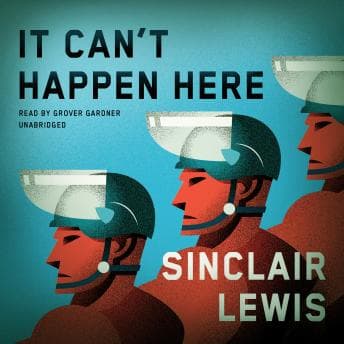
Let me get this out of the way: yes, people will read this book through the lens of modern American politics. They should. But the thing that makes It Can't Happen Here genuinely unsettling — and not just a historical curiosity — is how Lewis nails the mechanics of democratic erosion rather than just the aesthetics of it. Windrip doesn't seize power through tanks in the street. He does it through folksy charm, vague populist promises, and an electorate that's too tired, too cynical, or too entertained to notice they're handing away their own freedoms.
The protagonist, Doremus Jessup, is a small-town Vermont newspaper editor. He's educated, principled, a little smug — the kind of man who reads The New York Times and assumes that makes him immune to propaganda. Lewis loves Doremus but he doesn't spare him. Jessup spends the first third of the book convinced that American exceptionalism will protect the republic. "It can't happen here," he tells himself and his friends. The title isn't a thesis. It's a delusion.
This reminds me of what Hemingway said about how people go bankrupt — gradually, then suddenly. That's exactly how Lewis structures the political collapse. The Minute Men (Windrip's paramilitary thugs) don't appear fully formed. They grow out of small compromises, local cowardice, neighbor turning on neighbor. Lewis understood that fascism doesn't arrive in a foreign uniform. It arrives in your town's familiar clothes.
Grover Gardner and the Art of Restrained Dread
Grover Gardner narrates at a register that I'd call "controlled alarm." He doesn't shout. He doesn't perform. And that's precisely right for this material, because Jessup is a man who processes horror through intellect — through sentences, editorials, arguments at dinner parties — before the horror becomes physical and personal.
Gardner's voice carries an inherent gravitas that suits a 1930s New England newspaperman. His Doremus is dry, worried, occasionally sardonic. Where I think the performance works best is in the interior passages — Jessup's long stretches of self-argument, where he talks himself into and out of resistance. The narrator understands that pause is punctuation. Gardner lets Lewis's longer satirical passages breathe without rushing toward the next plot beat, and in a 14-and-a-half-hour listen, that patience matters.
Now — and I want to be honest here — Gardner's range for distinct character voices is limited. Windrip, the various Minute Men leaders, Jessup's family members — they don't sound dramatically different from one another. You won't always know who's talking in a crowded scene purely from voice. I found myself relying on Lewis's dialogue tags more than I'd like. For a novel with this many political figures, activists, and family members swirling around, a narrator with more tonal variety might've served the cast better. But Gardner's steadiness creates a specific effect: everything feels like it's being reported by one careful, increasingly frightened observer. And maybe that's the point.
The Prose Demands 1.0x (and Your Full Attention)
Sinclair Lewis writes like a man filling a notebook on a train. The sentences pile up — character sketches, political satire, snatches of dialogue, long parenthetical asides about American culture. It's dense, sometimes exhausting, occasionally brilliant. This is not a book that works at 1.5x while you're doing dishes. The prose deserves to be savored, and the satire only lands if you catch the rhythm Lewis is building.
I'll admit: there are stretches in the middle where Lewis gets bogged down in the bureaucratic machinery of Windrip's regime — committee names, regional power structures, lists of political appointees. My students would hate this. I love it. But I also understand the complaint. Lewis was a journalist at heart, and sometimes the reportorial instinct overwhelms the narrative momentum.
The final third, though — when Jessup moves from observer to dissident — genuinely shook me. I finished the last two hours grading papers at 11 PM, red pen in one hand, and I realized I hadn't marked a single essay in forty minutes.
Who This Is For (and Who Should Probably Start Elsewhere)
If you loved 1984 or Brave New World, this is their American ancestor — messier, more satirical, more rooted in real political behavior. If you're a Lewis reader who's only done Main Street or Babbitt, this is darker territory but unmistakably him. If you want a fast-paced dystopian thriller with clear heroes and villains, this will frustrate you. Lewis is interested in complicity, not heroism. The First Fifteen Lives of Harry August wrestles with that same question of complicity across centuries — what do you do when you can see the pattern repeating and no one around you believes you?
And look — this is why we still read the classics. Not because they predicted the future, but because they understood the patterns that keep repeating. Lewis didn't have a crystal ball. He had a mirror.
Worth Pausing the Faculty Meeting For
Grover Gardner delivers a sober, intelligent reading of a novel that feels uncomfortably relevant for something written nearly ninety years ago. The narration won't dazzle you, but it will carry you steadily through Lewis's dense, angry, sometimes messy, deeply American warning. Worth the credit. Worth the 14 hours. Principal Martinez, I was definitely not listening to this during your equity initiative presentation last Thursday. (I was.)