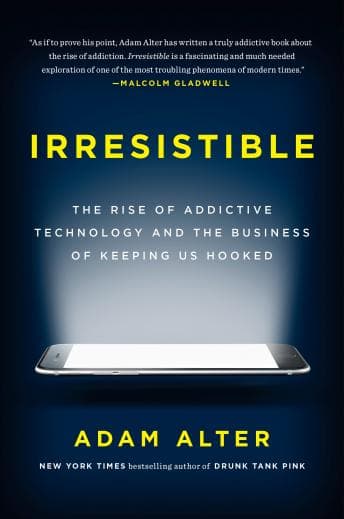

I checked my phone three times while listening to the first chapter of this book. The irony wasn't lost on me.
Adam Alter is doing what I spend my career trying to do—translating behavioral psychology research into something people actually want to engage with. And honestly? He's better at it than most academics I know. (Don't tell my department I said that.) As someone who teaches students about conditioning and reward schedules, I found myself nodding along like a bobblehead during my morning runs through Cambridge. The man knows his operant conditioning.
Why This Book Made Me Uncomfortable (In a Good Way)
Look, I study how narratives shape behavior. I analyze why people do the things they do. So when Alter starts breaking down the exact mechanisms tech companies use to hijack our dopamine systems, it hit different. He's essentially describing a massive psychological experiment being run on billions of people without their informed consent. My therapist would have thoughts about that. Speaking of therapeutic perspectives on behavioral patterns, Wired for Love applies similar neuroscience to relationship dynamics—turns out we're all running on reward systems, romantic or otherwise.
The research Alter cites is solid—variable reward schedules, social validation loops, the deliberate removal of stopping cues. This is Psych 101 stuff weaponized at scale. He traces the evolution from slot machines to Instagram likes, and the through-line is disturbingly clear. These products aren't accidentally addictive. They're engineered that way.
What makes this worth examining is Alter's refusal to be preachy about it. He's not wagging his finger at you for checking your email. He's explaining the architecture of the trap. There's a difference. And as someone who's read way too many self-help books that basically amount to "just try harder," I appreciated that he actually gets into the structural forces at play.
When the Academic Reads His Own Work
Alter reads his own book, which—okay, this can go either way with academics. We're not exactly known for our charisma. But he pulls it off. His voice is clear, pacing is steady, and he sounds like he's genuinely interested in what he's saying. (You'd be surprised how many authors narrate their own work sounding like they're reading a grocery list.)
That said, there are stretches—particularly when he's getting into the technical weeds of research methodology—where things get a little dry. I found myself zoning out during a few of the longer statistical explanations. Not his fault, really. That's just the nature of the material. I bumped up to 1.25x speed during those sections and it helped. The production quality is clean. No weird audio artifacts, no jarring transitions. Straightforward nonfiction listen.
Reverse-Engineering the Attention Trap
Alter doesn't just diagnose the problem. He reverse-engineers it. And this is where my research brain got excited. He breaks down specific design choices—the infinite scroll, the autoplay feature, the elimination of natural endpoints—and explains exactly why they work on a neurological level. The neurological angle reminded me of Mating in Captivity, which similarly dissects how understanding brain mechanisms can illuminate why we keep doing things that don't serve us. These aren't just annoying features. They're exploiting fundamental aspects of how human attention and reward-seeking work.
The section on children and screens was particularly sobering. He presents data on how screen time affects developing brains, and it's not great. But again, he's not catastrophizing. He's presenting evidence and letting you draw conclusions. I appreciated the restraint.
He also offers solutions, though I found these less compelling than the diagnosis. The suggestions—things like creating "stopping rules" and designing friction into your digital life—are sensible but not exactly revolutionary. It's the kind of advice that sounds good in theory but requires the very self-control these products are designed to undermine. Bit of a catch-22 there.
Who This Is (and Isn't) For
If you're interested in behavioral psychology, this is a solid primer on addiction mechanisms applied to technology. If you work in tech or design, this is basically a manual on what you're doing to people. (Whether that makes you uncomfortable is between you and your conscience.) Skip it if you're looking for a quick fix for your phone addiction—Alter is an academic, not a guru. He's here to explain, not to save you.
The Question That Stuck With Me
I found myself thinking about this book days after finishing it. Specifically, I noticed myself noticing when apps were using the exact techniques he described. That awareness alone might be worth the eight hours. My mother still doesn't understand why I need more books when I already have so many, but this one earned its spot on the shelf.
The question Alter leaves you with isn't really about technology. It's about agency. How much of what we do is actually chosen, and how much is designed? That's the kind of question I spend my career asking about fictional characters. Turns out it applies to the rest of us too.








![Steve Jobs [unabridged audiobook] audiobook cover](/_next/image?url=https%3A%2F%2Fcovers.audiobooks.com%2Fimages%2Fcovers%2Ffull%2F9788499923406.jpg&w=1920&q=75)